Monday, January 18, 2021

Plant Partners by Jessica Walliser

Book cover
Plant Partners
by Jessica Walliser


ISBN-13: 9781635861334
Paperback: 224 pages
Publisher: Storey Publishing, LLC
Released: December 22nd 2020


Source: ebook review copy from the publisher through NetGalley.

Book Description, Modified from Goodreads:
Companion planting has a long history of use by gardeners, but the explanation of why it works has been filled with folklore and conjecture. Plant Partners delivers a research-based rationale for this ever-popular growing technique, offering dozens of ways you can use scientifically tested plant partnerships to benefit your whole garden. Through an enhanced understanding of how plants interact with and influence each other, this guide suggests specific plant combinations that improve soil health and weed control, decrease pest damage, and increase biodiversity, resulting in real and measurable impacts in the garden.


My Review:
Plant Partners is a very informative book about garden plant pairings that help improve the yield and health of your harvest crops. The author talked about cover crops, living mulches, using allelopathy to combat weeds, plants that can be used as living trellises, plants that can be used to lure pests away from harvest crops, plants that help suppress disease in their plant partners, plants that attract beneficial insects, and plants that bring in more pollinators to the garden for an increased crop. She focused on plant pairings that have been studied at universities and such for their effectiveness.

She also talked about related issues, like no-till gardening or studies suggesting the reasons behind why these plant partners work well. The many pictures usually showed how the plants can be planted near each other (interplanted or planted in alternating rows). Her description of how to implement these plant partnerships (when to plant, where to plant, etc.) was also clear to me. Overall, I was so impressed with this book and its usefulness for a home gardener that I bought a physical copy because I'll be referring to it often. We're going to try some living mulch this year along with a couple of the plant partners that were suggested to bring in beneficial insects. I'd highly recommend this book to home gardeners.


If you've read this book, what do you think about it? I'd be honored if you wrote your own opinion of the book in the comments.


Excerpt: Read an excerpt using Google Preview.

Thursday, January 14, 2021

The Essential Guide to Adaptogens by Rachel Rozelle, ND

Book coverThe Essential Guide to Adaptogens by Rachel Rozelle, ND

ISBN-13: 978-1647399030
Paperback: 176 pages
Publisher: Rockridge Press
Released: December 8th 2020


Source: ebook review copy from the publisher through Amazon Vine.

Book Description, Modified from Goodreads:
In the world of natural medicine, adaptogens are superstars. These herbs and mushrooms have been used for centuries to help the body cope with stress of all kinds. The Essential Guide to Adaptogens puts the unique healing power of adaptogens in your hands. This up-to-date, research-driven guide walks you through using adaptogens like holy basil, Shatavari, cordyceps, and turmeric to support your body in managing depression, insomnia, hypertension and more.

Explore the history of adaptogens and learn about their wide range of benefits. Discover how they can be harnessed today to benefit immune health, sleep, hormone balance, brain function, and energy. Easy-to-follow recipes will empower you to introduce adaptogens into your lifestyle so you can begin healing, invigorating, and stress-proofing your mind and body.

Get introduced to the medicinal uses of adaptogens, and find out how to safely prepare the right dosage in a variety of forms. Meet each all-star adaptogen and learn its background, benefits, and usage guidelines—then dig into nourishing recipes. Find healthy lifestyle recommendations to further support you in achieving and maintaining optimal vitality and longevity.


My Review:
The Essential Guide to Adaptogens provides information about adaptogens. The author first talked about what adaptogens are and the benefits of taking them. She also talked about where to get them and how to use and store them. She then provided profiles for 15 herbs that included the Latin name, some basic information about the herb, the benefits, how to use it, the recommended amounts for different ways of using it (like a tincture or a capsule), any safety cautions, and a recipe or two using it. Each profile also had a chart showing what part is used, additional names, common preparations, energetics and taste, medicinal properties, and what it's used for. The herbs that she covered were American ginseng, ashwagandha, Asian ginseng, cordyceps, eleuthero, guduchi, holy basil, licorice, maca, rhaponticum, rhodiola, schisandra, shatavari, shilajit, and turmeric.

She then covered several common problems along with some herbs to treat them. She talked about anxiety, depression, irritability, low libido, fatigue, poor concentration, insulin resistance, obesity, and hypertension. For each problem, she talked about the symptoms and causes as well as possible treatments. Obviously, many of these treatments were adaptogens but she also suggested some other herbs as well and their dosing. She also talked about other things you can do that helps, like exercise. The last section of the book talked about self inquiry, breath work, yoga, massage, and meditation. The book included some good information and was easy to understand. I'd recommend it to people that haven't heard about adaptogens before and are interested in herbal remedies.


If you've read this book, what do you think about it? I'd be honored if you wrote your own opinion of the book in the comments.


Wednesday, December 30, 2020

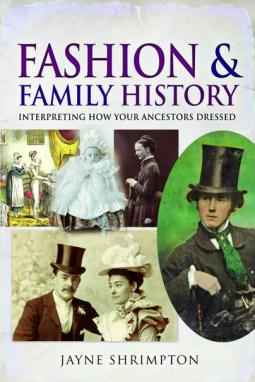
Fashion and Family History by Jayne Shrimpton

book cover
Fashion and Family History
by Jayne Shrimpton


ISBN-13: 9781526760265
Paperback: 200 pages
Publisher: Pen and Sword
Released: January 30th 2021

Source: ebook review copy from the publisher through NetGalley.

Book Description, Modified from Goodreads:
As Britain evolved during the 1800s from a slow-paced agrarian society into an urban-industrial nation, dress was transformed. Traditional rural styles declined and modern city modes, new workwear and holiday gear developed. Women sewed at home, while shopping advanced, novel textiles and mass-produced goods bringing affordable fashion to ordinary people. Many of our predecessors worked as professional garment-makers, laundresses or in other related trades: close to fashion production, as consumers they looked after their clothes.

The author explains how, understanding the social significance of dress, the Victorians observed strict etiquette through special costumes for Sundays, marriage and mourning. Poorer families struggled to maintain standards, but young single workers spent their wages on clothes, the older generation cultivating their own discreet style. Twentieth-century dress grew more relaxed and democratic as popular culture influenced fashion for recent generations who enjoyed sport, cinema, music and dancing.


My Review:
Fashion and Family History describes British fashions from 1800 to 1950. The author first described women's dress, men's dress, and children's dress (including babies) and how it changed throughout these years. She then went into more detail about the differences between city fashions and what rural people would wear, what was worn for business, uniforms for servants, department store employees, etc., what made up "Sunday best" clothing, what was worn for travel and holidays, sports (horseback riding, tennis, cycling, motoring, golf, walking), for brides at weddings, mourning attire, and evening dress. She also talked about activities that involved fashion and clothing, like sewing, being a seamstress or laundress, the rise of patterns and sewing machines, knitting, etc. She also described the care of clothes of different materials: how it was washed, ironed, starched, and stored.

There were some photographs and fashion plates showing the different fashions, but there were not very many of these. There were more for the 1900s than the 1800s, and even there, the photos did not show every change of fashion. Overall, the descriptions were clear enough that I could identify the clothes in the photographs. Since the aim of the book is helping people date old photos and paintings by the fashion, it should be helpful in that regard. I got this book because I was interested in seeing what the different fashions looked like, so I was disappointed that there weren't more fashion illustrations and photographs included.


If you've read this book, what do you think about it? I'd be honored if you wrote your own opinion of the book in the comments.


Friday, December 18, 2020

Authentic Homemade Pasta by Carmella Alvaro

book cover
Authentic Homemade Pasta
by Carmella Alvaro


ISBN-13: 978-1647397449
Paperback: 266 pages
Publisher: Rockridge Press
Released: October 20, 2020

Source: review copy from the publisher through Amazon Vine.

Book Description, Modified from Goodreads:
With high-quality ingredients and just the right amount of care, you can create delicious homemade pasta in your own kitchen. Authentic Homemade Pasta is a comprehensive homemade pasta cookbook filled with 100 tried-and-true recipes for noodles, pasta dishes, sauces, and fillings so you can make classic Italian meals you’re proud to serve. Get step-by-step instructions for mixing pasta dough by hand and with a machine, rolling out and shaping dough, and storing or cooking the finished results.

Inside this unique homemade pasta cookbook, you’ll find master dough recipes for egg pasta, whole-wheat flour pasta, and more. Explore “Learn and Make” recipes that teach you dough-shaping techniques with step-by-step photos and instructions for cut, hand-shaped, stuffed, and extruded pastas, as well as gnocchi and gnudi. Then move on to recipes for sauces, fillings, toppings, and complete pasta dishes.


My Review:
Authentic Homemade Pasta teaches how to make your own handmade pasta. The author started by explaining the different supplies needed and then provided several different pasta dough recipes (including one for gluten-free pasta and for pasta that has herbs or spinach, etc. in it). She then had sections for cut pasta, shaped pasta, stuffed pasta, and a small section on machine-extruded pasta. For each section, there were one or two pastas that had a step-by-step, how-to demonstration with six pictures. The rest of the section was a variety of Italian recipes, but many of these recipes had pasta variations that were slight modifications of those taught in the demonstration. Most of these were simple enough to understand, but most did not have a picture. I wasn't sure I understood the instructions on some of the more complex pastas that had no pictures.

The sauce part of the recipes used a lot of vegetable, herb, meat, and dairy. There were also some basic sauce recipes at the end of the book. While the recipes are based on regional Italian recipes, the ingredients looked like they can be found in America. Personally, I'm more interested in learning how to make pasta than in having a bunch of recipes, so I was disappointed that there weren't more pasta-making demonstration pages with illustrative pictures. Still, I'd recommend this book to those interested in learning to make handmade pasta.


If you've read this book, what do you think about it? I'd be honored if you wrote your own opinion of the book in the comments.


Thursday, December 10, 2020

The Light Ages by Seb Falk

book cover
The Light Ages
by Seb Falk


ISBN-13: 9781324002932
Hardcover: 416 pages
Publisher: W. W. Norton Company
Released: November 17th 2020

Source: review copy from the publisher.

Book Description, Modified from Goodreads:
Soaring Gothic cathedrals, violent crusades, the Black Death: these are the dramatic forces that shaped the medieval era. But the so-called Dark Ages also gave us the first universities, eyeglasses, and mechanical clocks, proving that the Middle Ages were home to a vibrant scientific culture.

In The Light Ages, Cambridge science historian Seb Falk takes us on an immersive tour of medieval science through the story of one fourteenth-century monk, John of Westwyk. From multiplying Roman numerals to navigating by the stars, curing disease, and telling time with an ancient astrolabe, we learn emerging science alongside Westwyk, while following the gripping story of the struggles and successes of an ordinary man in a precarious world. An enlightening history that argues that these times weren’t so dark after all, The Light Ages shows how medieval ideas continue to color how we see the world today.


My Review:
The Light Ages explained in detail some of the mathematics, astronomy, and scientific knowledge of the 1300s. Not much is known about a monk named John of Westwyk. What little is known about his life is used as a frame for talking about the mathematics and science that he would've encountered and used. The author didn't just tell what he knew but explained in detail how they did the mathematics or used the machines.

He explained how they could tell time by shadows and the sun's location, how to count using Roman numerals and the sexagesimal system, why they changed over to using Hindu-Arabic numerals, and the development of precise clocks and accurate calendars from the close observation of the sun, moon, and stars. He explained how monks were sent to universities and the opposition to their learning and debating Aristotle's ideas before learning theology. He explained how to use an astrolabe, the Albion device developed at St. Albans, and how astrology was calculated and used to predict weather. He talked about St. Albans and the priory at Tynemouth and how some monks went on crusade. He explained why many medieval maps are distorted but served a distinct, useful purpose, the development of compasses and the exploration of magnetic attraction, and general information about medicine at the time and what was used for dysentery. He ended by explaining John's creation--a computer of the planets--and how it could be used to quickly find where the planets were in the sky. Overall, this book may be of most interest to mathematicians as a lot of math was described, but it does convey how scientific knowledge was being exchanged between cultures and religions and actively developed during the Middle Ages.


If you've read this book, what do you think about it? I'd be honored if you wrote your own opinion of the book in the comments.


Excerpt: Read an excerpt using Google Preview.

Tuesday, December 8, 2020

The No-Till Organic Vegetable Farm by Daniel Mays

book cover
The No-Till Organic Vegetable Farm
by Daniel Mays


ISBN-13: 9781635861891
Harcover: 256 pages
Publisher: Storey Publishing, LLC
Released: October 13th 2020

Source: ebook review copy from the publisher through NetGalley.

Book Description, Modified from Goodreads:
No-till farming — a method of growing crops and providing pasture without disturbing the soil with tillage — has become a proven and enormously important alternative to standard farming practices. In this comprehensive guide to no-till vegetable farming for aspiring and beginning farmers, author Daniel Mays — himself the owner and manager of a no-till farm in Maine — details the many benefits of this system, along with how to establish no-till beds, intensive crop planning, mulching strategies, techniques and timing of occultation and solarization, selection and timing of no-till cover crops, holistic approaches to weed management, and efficient methods of harvest and post-harvest handling.

The book presents innovative labor structures that replace reliance on expensive machinery, as well as streamlined planning and record-keeping tools, marketing strategies, and the value of community engagement through programs like CSA, food justice initiatives, and on-farm education. It shows farmers concerned about the future of their profession and the planet that, together, all of these elements form a cohesive system that works toward the health of the soil, the farm as a whole, the natural environment, and the people it feeds and employs.


My Review:
The No-Till Organic Vegetable Farm details how to start and run a successful market garden using organic and no-till methods. The focus of the book was more on teaching a beginner the details needed to successfully buy a farm and start a market garden. However, the author also included details about how to do this using an organic, no-till method. He covered topics like:

What to look for when buying land, things to think about when designing the farm layout, how to break ground (with and without tilling) and start your vegetable beds, things to consider when deciding what to plant and where to plant it, making a greenhouse and equipping it, transplanting and direct seeding, ways to irrigate and how to maintain a system, how to deal with weeds including mulching and manual weeding, using compost as mulch, using cover crops and what to do when it's time to plant, how to break up compaction and avoid it to begin with, multi-cropping, planting beneficial plants elsewhere on the farm, using livestock with the beds, fertilization, dealing with pests and disease, how to harvest efficiently and keep crops clean and fresh, the different ways you can sell your produce, how to hire laborers, record keeping, and more.

He gave specific examples of how they do these various things on his farm and included many full-color photographs of what this looks like. This is a very informative book and is probably most helpful to those who live in a more northern climate like he does (in Maine). I felt like he was not aware of some issues that come up in the South where the winters are mild. Since I'm already an organic farmer and was mostly interested in the no-till method, I was a little disappointed that he did not cover these issues pertinent to my region. However, I did learn quite a lot of new information about no-till and how it works, and I plan to use some of this information next year in my hobby garden.


If you've read this book, what do you think about it? I'd be honored if you wrote your own opinion of the book in the comments.


Excerpt: Read an excerpt using Google Preview.

Monday, December 7, 2020

Python Programming for Beginners by Patricia Foster

book cover
Python Programming for Beginners
by Patricia Foster


ISBN-13: 978-1646113880
Paperback: 198 pages
Publisher: Rockridge Press
Released: October 20, 2020

Source: review copy from the publisher through Amazon Vine.

Book Description, Modified from Goodreads:
Think like a programmer with this fun beginner’s guide to Python for ages 10 to 14. Python Programming for Beginners is the perfect way to introduce aspiring coders to this simple and powerful coding language. This book is packed full of fun and creative activities that make learning a blast!

In Python Programming for Beginners, kids will start off with the basics, learning all about fundamental coding concepts and how they can put these concepts together in Python to build their own games and programs. Each chapter focuses on a different coding concept—like variables, data types, and loops—and features three awesome coding activities to try. These activities get more difficult as they go, so young coders can see just how much their skills are growing. By the end of Python Programming for Beginners, they’ll create their own fully functional sci-fi game and crack the code to a secret message!

No coding experience needed! Designed for kids, this Python programming book is filled with step-by-step directions, simple explanations, and detailed code breakdowns. Kids will build their programming skills, learn how to troubleshoot bugs with a handy bug-hunting guide, and practice their Python programming knowledge with cool activities.

Python is an awesome starting language for kids! It’s a powerful programming language that can be used for lots of projects but features simple syntax so beginners can focus on learning programming logic. Set kids up for a lifetime of programming success with Python Programming for Beginners.


My Review:
Python Programming for Beginners teaches the process of coding, specifically how to code in Python. It's targeted at ages 10 through 14 and it's explained clearly enough that it should be understandable to that age range, but it's also useful for adults who want to learn the basic concepts of coding. The author did a good job of showing how to think through what needs to be in the code and how to identify the problem and fix bugs that happen in the code. She taught how to get set up with Python and explained what a certain type (variables, data types, loops, etc.) of code does, how to write it so that it will work, and then showed step-by-step how to use it by coding a simple animation or game. She then walked you through two more projects, each involving progressively more advanced coding, as well as suggested some changes that the reader might try by themselves. By the end, I felt like I finally understood the basics of coding and that I could use Python to create from scratch, not just copy and modify the game code in the book. Overall, I'd highly recommend this book.


If you've read this book, what do you think about it? I'd be honored if you wrote your own opinion of the book in the comments.