Showing posts with label engineering. Show all posts

Tuesday, April 6, 2021

Castle Builders by Malcolm Hislop

Book cover
Castle Builders
by Malcolm Hislop


ISBN-13: 9781526796615
Paperback: 272 pages
Publisher: Pen and Sword Archaeology
Released: April 30th 2021


Source: ebook review copy from the publisher through NetGalley.

Book Description, Modified from Goodreads:
In Castle Builders, Malcolm Hislop looks at the hugely popular subject of castles from the unusual perspective of design and construction. We discover something of the personalities behind their creation - the architects and craftsmen - and, furthermore, the techniques they employed, and how style and technology was disseminated. Castle Builders takes both a thematic and a chronological approach to the design and construction of castles, providing the reader with clear lines of development. Themes include earth, timber and stone construction techniques, the evolution of the great tower, the development of military engineering, the progression of domestic accommodation, and the degree to which aesthetics contributed to castle design.


My Review:
Castle Builders is a detailed look at the archaeological evidence for how castles were built in Great Britian, from manors on raised earthworks to carpentry walls, floors, and roofs, to masonry fortification, buildings, and plumbing issues. The author spent a lot of time providing details, from the exact dimensions of the moats to the name of the engineer that headed the building project to the apparent spread and development of different architectural features based on when different castles were built. Some pictures of the described features were included and were very interesting, illustrating his points. If you want to know the layers of subsoil found mounded next to the moat and the implications for how both were created, you'll find that information in this book. Architectural and castle-related terms were rarely defined in the text, though there's a glossary in the back. However, this is probably too detailed to be of interest if you don't know the basic terms already. While the book provided a great deal of information and analysis, it's probably too technical to interest someone with only a casual interest in castles.


If you've read this book, what do you think about it? I'd be honored if you wrote your own opinion of the book in the comments.


Excerpt: Read an excerpt using Google Preview.

Tuesday, October 6, 2020

The 99% Invisible City by Roman Mars; Kurt Kohlstedt

book cover
The 99% Invisible City
by Roman Mars;
Kurt Kohlstedt


ISBN-13: 9780358126607
Hardcover: 400 pages
Publisher: Houghton Mifflin Harcourt
Released: October 6th 2020

Source: ebook review copy from the publisher through NetGalley.

Book Description, Modified from Goodreads:
Have you ever wondered what those bright, squiggly graffiti marks on the sidewalk mean? Or stopped to consider why you don't see metal fire escapes on new buildings? Or pondered the story behind those dancing inflatable figures in car dealerships? 99% Invisible is a big-ideas podcast about small-seeming things, revealing stories baked into the buildings we inhabit, the streets we drive, and the sidewalks we traverse. The show celebrates design and architecture in all of its functional glory and accidental absurdity, with intriguing tales of both designers and the people impacted by their designs.

Now, in The 99% Invisible City: A Field Guide to Hidden World of Everyday Design, host Roman Mars and coauthor Kurt Kohlstedt zoom in on the various elements that make our cities work, exploring the origins and other fascinating stories behind everything from power grids and fire escapes to drinking fountains and street signs. With deeply researched entries and beautiful line drawings throughout, The 99% Invisible City will captivate devoted fans of the show and anyone curious about design, urban environments, and the unsung marvels of the world around them.


My Review:
The 99% Invisible City explains how different design features in cities have come about and why they are that way. These are short entries, only two or three pages long per topic. Rather than looking at the best design, we're often told about a poor design that doesn't work. Or we're told how someone was inspired to create something and how it works. The book covered things like what various sidewalk markings mean, how to spot fake façades and what they might cover up, how a city changes over time and how to spot marks of the past that have been left behind, how to create a memorable flag or warning symbol, how advertising can literally hide things, why manhole covers are round and have a design on the top, safety features that are built into signs and such, design considerations behind creating cycling lanes, the naming of streets, how revolving doors came about, how regulations have affected architecture over time, lots of things about skyscrapers, and more. There are some rough line drawings that show the object being discussed. Actual pictures would have been better, but you get an idea of what the thing being talked about look like. Overall, I'd recommend this interesting book.


If you've read this book, what do you think about it? I'd be honored if you wrote your own opinion of the book in the comments.


Monday, April 13, 2015

The Most Powerful Idea in the World by William Rosen

book cover
The Most Powerful Idea in the World
by William Rosen


ISBN-13: 9781400067053
Hardcover: 400 pages
Publisher: Random House
Released: June 1, 2010

Source: Borrowed from my local library.

Book Description, Modified from Back Cover:
In The Most Powerful Idea in the World, William Rosen tells the story of the men responsible for the Industrial Revolution and the machine that drove it—the steam engine. In the process he tackles the question that has obsessed historians ever since: What made eighteenth-century Britain such fertile soil for inventors? Rosen’s answer focuses on a simple notion that had become enshrined in British law the century before: that people had the right to own and profit from their ideas.

The result was a period of frantic innovation revolving particularly around the promise of steam power. Rosen traces the steam engine’s history from its early days as a clumsy but sturdy machine, to its coming-of-age driving the wheels of mills and factories, to its maturity as a transporter for people and freight by rail and by sea. Along the way we meet inventors as Thomas Newcomen and James Watt, scientists including Robert Boyle and Joseph Black, and philosophers John Locke and Adam Smith, as well as learn about the technologies and developments necessary for the creation of steam engines.


My Review:
The Most Powerful Idea in the World is a "Connections"-style book about the developments in technology and ideas that were needed to create an effective steam engine. The author covered the economic, legal, and social issues that came together to foster invention. He also followed various threads of technological developments from ancient times to 1829 that were needed for the creation of steam locomotives. He talked about many inventors and inventions along the way, including developments in iron working, precision measurement, textiles, mining, and science.

If you're looking for a book that clearly explains how each invention worked and includes diagrams, this isn't it. There were only a few diagrams, and the descriptions in the text didn't give enough information for someone not already familiar with the science and engineering behind it. Since the descriptions didn't really enlighten me, they actually went on longer than I needed to understand the overall story of development. A timeline would have been useful, too. The author reset where we were in time with each new topic. Each technology or idea led to the next within each chapter, but I started to lose track of when the events of other chapters happened in relation to the one I was currently reading.

Overall, this is a fairly readable book with a lot of interesting connections about the legal protection and technology needed for the development of the first practical steam locomotive. Just keep in mind that it's a bit technical while still not fully explaining how the various technologies work.


If you've read this book, what do you think about it? I'd be honored if you wrote your own opinion of the book in the comments.


Excerpt: Read an excerpt using Google Preview.

Tuesday, April 8, 2014

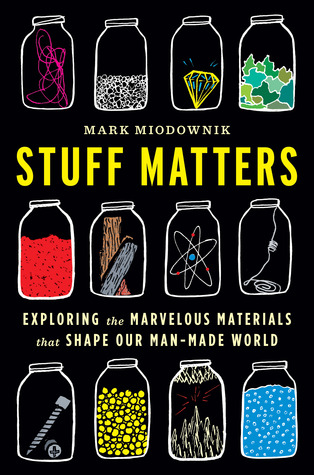
Stuff Matters by Mark Miodownik

This is another review done as a member of Amazon Vine, so I'm posting a description of the book with a direct link to my review on Amazon.

book cover
Stuff Matters
by Mark Miodownik


ISBN-13: 9780544236042
Hardcover: 272 pages
Publisher: Houghton Mifflin Harcourt
Released: May 27, 2014

Book Description, Modified from Back Cover:
Why is glass see-through? What makes elastic stretchy? Why does a paper clip bend? Why does any material look and behave the way it does? These are the sorts of questions that Mark Miodownik is constantly asking himself. A globally-renowned materials scientist, Miodownik has spent his life exploring objects as ordinary as an envelope and as unexpected as concrete cloth, uncovering the fascinating secrets that hold together our physical world.

From the teacup to the jet engine, the silicon chip to the paper clip, the plastic in our appliances to the elastic in our underpants, our lives are overflowing with materials. Full of enthralling tales of the miracles of engineering that permeate our lives, Stuff Matters will make you see stuff in a whole new way

My Review: Link to my review on Amazon.

Tuesday, May 4, 2010

Discovery of Design by Donald DeYoung & Derrik Hobbs


book cover


Discovery of Design
by Donald DeYoung & Derrik Hobbs


Trade Paperback: 240 pages
Publisher: Master Books
First Released: 2009


Source: Review copy from the publisher.

Back Cover Description:
From the frontiers of scientific discovery, researchers are now taking design elements from the natural world and creating extraordinary breakthroughs that benefit our health, our quality of life, our ability to communicate, and even help us work more efficiently.

An exciting look at cutting-edge scientific advances, Discovery of Design highlights incredible examples that include:

How things like batteries, human organ repair, microlenses, automotive engineering, paint, and even credit card security all have links to natural designs

Innovations like solar panels in space unfurled using technology gleaned from beech tree leaves, and optic research rooted in the photonic properties of opal gemstones

Current and future research from the fields of stealth technology, communications, cosmetics, nanotechnology, surveillance, and more!

Take a fantastic journey into the intersection of science and God's blueprints for life - discovering answers to some of the most intricate challenges we face. Experience this powerful apologetics message in a multi-purpose resource as a personal enrichment tool or as an educational supplement.


Review:
Discovery of Design explored more than 79 examples of biomimicry--where humans have based technological designs off of mechanisms found in microorganisms, insects, flying animals (mainly birds), water animals (fish, whales, etc.), land animals (including a dinosaur), humans, plants, and even non-living things.

Some of the descriptions were more detailed than others. Some were potential or future applications while most where examples of already-in-use technology. The information was written at a level that a teenager could understand, and there was a glossary in the back for the few scientific terms.

Each entry focused on an interesting ability found in nature and then explained how humans have (or are trying to) create something based on that design to solve a problem or increase the efficiency of a current design. Black-and-white pictures illustrated the text. The book referenced where this information came from for further study (articles, books, or internet search words). There were also three "study" questions per entry that were related to the information in the entry but would require a search elsewhere for the answers. Or you can just look in the back of the book for the answers.

There is an intelligent design theme to this book with the Biblical God as the Designer, but that's not the main focus or purpose of the book.

Overall, I'd recommend this very interesting book to people who like engineering design, design in nature, and/or biomimicry.


If you've read this book, what do you think about it? I'd be honored if you wrote your own opinion of the book in the comments.


Excerpt from pages 48-49
Termite Mound => Ventilation

Termite mounds across the plains of southern Africa reach heights of 10 feet (3 m) or more. Engineers have long been impressed with the self-cooling system built into the mounds by Macrotermes michaelseni termites. Their food supply is a "farmed" fungus that must be kept at exactly 87F (30C). However, the outside temperature varies widely between 35 and 104F (2-40C). To compensate, the termites open or close a series of internal heating and cooling vents. These vents connect numerous tunnels that maintain temperature along with ideal moisture and oxygen levels. The network of tunnels somewhat resembles our internal circulatory system of veins and arteries. When rain occurs, clay on the surface of the termite mound swells and provides waterproof protection. During dry periods, the clay contracts and ventilation cracks appear.

Architects are making use of the principles of termite mound ventilation. One result is the Eastgate Building in the capital city of Zimbabwe, Harare. This 18-story shopping complex has no mechanical air conditioning or heating, yet remains comfortable. The interior ventilation system of ductwork is based on the structure of termite mounds. Outside breezes pull fresh air throughout the building. As a result, the Eastgate structure uses just 10 percent of the energy of a conventional building.


Internet search words: air conditioning, Eastgate Building, termite


Questions for further study:
1. How many termites may live in a single African mound?
2. Describe how the termite mound heating and cooling vents operate.
3. What is the average temperature of Zimbabwe's capital city, Harare?

A: pg. 196