Showing posts with label East Asia. Show all posts

Saturday, January 31, 2015

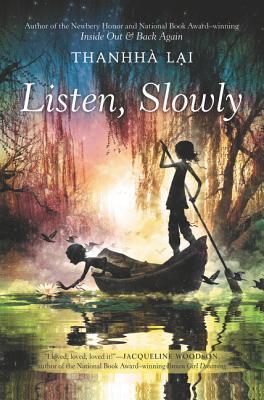
Listen, Slowly by Thanhha Lai

As a member of Amazon Vine, I'm able to review books through them, but--as I understand the terms--I'm only allowed to post my review on Amazon. Because I liked this book, I'm posting a description of the book here with a direct link to my review on Amazon. This book is a novel, but it reads like a non-fiction so I'm also posting it here.

book cover
Listen, Slowly
by Thanhha Lai


ISBN-13: 9780062229182
Hardcover: 272 pages
Publisher: HarperCollins
Released: February 17, 2015

Source: Review copy from the publisher through Amazon Vine.

Book Description, Modified from Back Cover:
A California girl born and raised, Mai can't wait to spend her vacation at the beach. Instead, though, she has to travel to Vietnam with her grandmother, who is going back to find out what really happened to her husband during the Vietnam War. Mai's parents think this trip will be a great opportunity for their daughter to learn more about her culture.

But to Mai, those are their roots, not her own. Vietnam is hot, smelly, and the last place she wants to be. Besides barely speaking the language, she doesn't know the geography, the local customs, or even her distant relatives. To survive her trip, Mai must find a balance between her two completely different worlds.


My Review:
My review on Amazon.

If you've read this book, what do you think about it? I'd be honored if you wrote your own opinion of the book in the comments.


Monday, September 29, 2014

I Stand Corrected by Eden Collinsworth

This is another review done as a member of Amazon Vine, so I'm posting a description of the book with a direct link to my review on Amazon.

book cover
I Stand Corrected
by Eden Collinsworth


ISBN-13: 9780385538695
Hardcover: 272 pages
Publisher: Nan A. Talese
Released: October 7, 2014

Book Description, Modified from Back Cover:
A fascinating fusion of memoir, manners, and cultural history from a successful businesswoman well versed in the unique challenges of working in contemporary China.

During the course of a career that has, quite literarily, moved her around the world, no country has fascinated Eden Collinsworth more than China, where she has borne witness to its profound transformation. In I Stand Corrected, Collinsworth tells the entertaining and insightful story of the year she spent living among the Chinese while writing a book featuring advice on such topics as personal hygiene, the rules of the handshake, and making sense of foreigners. Scrutinizing etiquette, she explains Chinese practices and reveals much about our own Western culture. At the same time, I Stand Corrected is a wry reflection on the peripatetic career she led while single-handedly raising her son.

My Review: Link to my review on Amazon.

Tuesday, February 8, 2011

Long Road Home by Kim Yong


book cover

Long Road Home:
Testimony of a North Korean Camp Survivor
by Kim Yong
with Kim Suk-Young


ISBN-13: 978-0-231-14746-0
Hardback: 184 pages
Publisher: Columbia University Press
Released: May 2009


Source: Electronic review copy from publisher through Netgalley.

Book Description, my take:
Long Road Home shares the remarkable story of a former North Korean military official who served six years of a life sentence in a penal camp before managing to escape.

When Kim Yong was three years old, his father was executed as a spy for the United States. The stigma of the father's guilt would forever limit his son's future, so Kim Yong's mother placed him in an orphanage for war orphans by giving him a false background. He was adopted by a high-ranking political official, entered the military, and eventually became a lieutenant colonel in the national security police. His job gave him unusual freedom of movement throughout the country, and he encountered corruption at all levels.

He married, had children, and enjoyed access to luxuries others were denied. But when he was recommended for a promotion which required a meticulous background clearance check, his true identity was uncovered. He was imprisoned in two different penal camps over a six year period and forced to do hard labor on a starvation diet until his amazing, narrow escape in 1999.


My Review:
Long Road Home is a biography written by Kim Suk-Young using transcripts of interviews with Kim Yong, but the book is written in first person like a memoir. It was a well-written, amazing story that kept my interest throughout. Kim Yong's story gave insight into many aspects of life in North Korea as well as describing what the penal camps were like and why people were sent there.

The introduction explained how Korea ended up as North and South Korea and other necessarily background information. The first part of the book (up until he got married at age 28) gave a broad overview of that period of his life with only a few, life-changing events told in detail. Afterward, much more detail was given, including graphic descriptions of how bad the suffering was.

There were black and white maps showing his escape route and the location of the two penal labor camps, including satellite maps of the camps. Overall, I'd highly recommend this memoir to those wanting to know more about life in North Korea.


If you've read this book, what do you think about it? I'd be honored if you wrote your own opinion of the book in the comments.


Excerpt from Chapter Four
In North Korea, everyone knows that a labor camp is a place where life is suspended. One does not live there, one slowly dies there. I was simply another dead soul in Camp No. 14.

At 5:00 a.m. everyone was awakened. By 6:00 a.m. the prisoners had finished their meager breakfast and marched toward the workplace. Since the mine shafts were hidden in deep valleys, nobody could see the sun light. At 7:00 we were already busy at work. Between 12:30 and 1:00 p.m., we had a quick lunch underground in the mine shaft. In order to go to the toilet, the prisoners had to wait to form groups because there was little light and they had to share one bulb to move around. One person had to carry the lamp and lead the way. Then we came out of the shaft around 11:30 p.m. and ate supper outside in darkness. According to the rules, the work was supposed to end by 8:00 p.m., or by 9:00 p.m. at the latest. However, no guard bothered to enforce this. The only real rules in Camp No. 14 were the guards’ decisions. After work, we marched back to our barracks and stayed up another hour for political struggle consisting of mutual and self criticism. At 1:00 a.m., three hours later than the camp regulations, everyone went to sleep. Before my arrest, I used to sleep eight hours a night, on the average. At the camp, that was cut in half.

Even by notoriously subhuman North Korean camp standards, No. 14 was the worst of them all. To my knowledge, no human being had escaped it alive. Prisoners were beyond the point of feeling hungry, so they felt constantly delirious. But what was really killing us was psychological and emotional torture. No family members were allowed to stay together. Upon arrival at the camp, husbands and wives were separated. Children were allowed to stay with their mother until they turned twelve; then they were segregated according to sex and kept in separate barracks. Once families were separated, there was no way of knowing whether other members were dead or alive. The only chance they might have to see each other was during the public executions when all prisoners were gathered in the courtyard.

Read more of the excerpt.

Tuesday, February 2, 2010

The Culture of the Book in Tibet by Kurtis R. Schaeffer


book cover


The Culture of the Book in Tibet
by Kurtis R. Schaeffer


Hardback: 264 pages
Publisher: Columbia University Press
First Released: 2009

Publisher's Book Page


Source: Review copy from the publisher.

Back Cover Description:
The history of the book in Tibet involves more than literary trends and trade routes. Functioning as material, intellectual, and symbolic object, the book has been an instrumental tool in the construction of Tibetan power and authority, and its history opens a crucial window onto the cultural, intellectual, and economic life of an immensely influential Buddhist society.

Spanning the fourteenth to the eighteenth centuries, Kurtis R. Schaeffer envisions the scholars and hermits, madmen and ministers, kings and queens who produced Tibet's massive canons. He describes how Tibetan scholars edited and printed works of religion, literature, art, and science and what this indicates about the interrelation of material and cultural practices. The Tibetan book is at once the embodiment of the Buddha's voice, a principal means of education, a source of tradition and authority, an economic product, a finely crafted aesthetic object, a medium of Buddhist written culture, and a symbol of the religion itself. Books stood at the center of debates on the role of libraries in religious institutions, the relative merits of oral and written teachings, and the economy of religion in Tibet.

A meticulous study that draws on more than 150 understudied Tibetan sources, The Culture of the Book in Tibet is the first volume to trace this singular history. Through a single object, Schaeffer accesses a greater understanding of the cultural and social history of the Tibetan plateau.


Review:
The Culture of the Book took a detailed look at book-making and the place of books in society in Tibet--a culture in which religious books are literally worshiped--during the 14th-18th centuries. While the books used in the examples were mainly Buddhist texts, the author only touched on Buddhist teachings as they related to the making, ownership, and value of the book. He covered several specific case studies where letters or texts were available which spoke about the process of making books (getting a patron, gathering materials, editing, translating, writing or cutting blocks and block printing the book, etc.) during the different centuries and in different areas of Tibet.

He also covered the social issues surrounding books, like how books were passed on after a person died, how donations were gathered to fund the expensive book-making project, and so on. The appendices contained the full text of a letter quoted in part in the book, a section explaining the contents of the Buddhist Canons for those of us who didn't know, and a chart showing the cost of making the Canon in his Degé example.

The wording used was formal but not technical, so it was easy to understand. I found the book interesting, though I felt at times like I would have gotten even more out of it if I was somewhat familiar with Tibetan Buddhism and the history during the time period covered. But maybe not. Overall, I'd recommend this book to anyone with an interest in how Tibetan Buddhism influenced book making in Tibet during the 14th-18th centuries.


If you've read this book, what do you think about it? I'd be honored if you wrote your own opinion of the book in the comments.


Excerpt from Chapter One
In the conclusion to one of his many works on esoteric Buddhist practice, Büton Rinchendrup, the great fourteenth-century scholar of Shalu monastery in west-central Tibet, recounts a story that one of his masters, Lama Pakpa O, had related to him. It was a cautionary tale about books. When Pakpa O was himself a student, his master, having grown quite old, had become unable to memorize teachings correctly. The master ordered Pakpa O to write down a certain text for him so he might read the work that now lay beyond his mnemonic abilities. Pakpa O had been explicitly ordered by another master never to write these teachings down, so this placed him in the difficult position of having to break one command in order to fulfill another. He resolved the dilemma by writing only an outline of the teachings for his aging mentor.

As Pakpa O related the tale, Büton asked that such a ban not be placed upon him, for he wished to compose a more extensive treatise on the practice. Pakpa O, seeing that he had not impressed upon his disciple the gravity of this ban on recording the teachings on paper, then offered a sort of commentary on the episode. "Writing down the instructions of an oral lineage," he began allegorically, "is like the king descending to the common people or wandering about a village. The negative consequences are manifold." And he listed the harmful costs: "The power and benefit of the instruction become vitiated. After the text exists, the practical instructions will not be sought after, and people will come to know the instruction only by obtaining the text. In the end it will become merely a reading transmission and thus the lineage of the real instruction will be severed."

Yet despite these concerns, Pakpa O consented to let Büton write "If [you] wish to do so, by all means do." But, he cautioned, "do not let the profound instructions become merely a reading transmission." The problem was not the act of putting the oral instructions down on paper, per se, but rather the danger that the transformation to a more permanent and portable communication medium might render direct master-disciple relationships unnecessary in the minds of those seeking instruction.


[From p. 142, a look at how things changed over time:]

At the beginning of a lengthy passage on the virtues of writing books [Shuchen] lists a set of ten scholarly practices that, as he says, "constitute the heart of the practice." As Shuchen himself relates, the following list is based upon the well-known work by Maitreya, Mahyantavibhaga. These practices are: 1) writing down texts of the holy teachings; 2) making offerings to books; 3) giving them to others; 4) hearing them being read by others; 5) reading them for oneself; 6) acquiring books; 7) explaining both the words and the meaning without error; 8) reciting them; 9) contemplating their meaning; and finally 10) meditating in accordance with what is explained in books. In contrast with the importance placed on orally transmitted teachings, often held in Tibetan literature to be integral to the authoritative transmission of Buddhist teachings, Shuchen uses this scripturally sanctioned outline for religious scholarly method as a support for the enterprise of printing.

Monday, March 30, 2009

A Comrade Lost and Found by Jan Wong


A Comrade Lost and Found


A Comrade Lost and Found:
A Beijing Story
by Jan Wong


Hardback: 322 pages
Publisher: Houghton Mifflin Harcourt
First Released: 2009

Buy from Amazon


Source: review copy from publisher

Back Cover Description:
A journalist’s search through Beijing for the classmate she betrayed during the Cultural Revolution reveals three decades of Chinese transformation.

In the early 1970s, at the height of the Cultural Revolution, Jan Wong traveled from Canada to become one of only two Westerners permitted to study at Beijing University. One day a fellow student, Yin Luoyi, asked for help getting to the United States. Wong, then a starry-eyed Maoist, immediately reported her to the authorities, and shortly thereafter Yin disappeared.

Thirty-three years later, hoping to make amends, Wong revisits the Chinese capital, with her husband and teenage sons in tow, to search for the person who has haunted her conscience. At the very least, she wants to discover whether Yin survived. But Wong finds the city bewildering—ancient landmarks have made way for luxury condominiums. In the new Beijing, phone numbers, addresses, and even names change with startling frequency. In a society determined to bury the past, Yin Luoyi will be hard to find.

As she traces her way from one former comrade to the next, Wong unearths not only the fate of the woman she betrayed but a web of fates that mirrors the strange and dramatic journey of contemporary China and rekindles all of her love for—and disillusionment with—her ancestral land.


Review:
This book is a memoir covering the author's experiences in China when she was college-aged up until just before the Beijing Olympics. The frame story is about her month-long trip to Beijing to find and apologize to a woman she betrayed when she was much younger. As the author tells about her present-day trip, she segues into relevant information about what China is like now and what it used to be like.

It's China like you probably never imagined it. The descriptions of city life are vivid and made me feel as if I was experiencing the trip with her. From the party held in her honor by her old teachers to roaming the streets and looking into bars and massage parlors, the trip is a fascinating one.

The author has the ability to laugh at herself and all but the most serious parts are told with a touch of loving humor.

Overall, the book was well-written and very interesting. I'd highly recommend this book to anyone who is interested in what China (or, at least, Beijing) is like now and how it's changed in the last forty years.


If you've read this book, what do you think about it? I'd be honored if you wrote your own opinion of the book in the comments.


Excerpt: Chapter One
Mission Impossible

On the tarmac at Newark International Airport, a heat wave makes the August air dance. Inside our Boeing 777, a black flight attendant sings out the standard Chinese greeting. "Ni hao," she chimes, mangling the tones. Nevertheless the passengers, mostly mainland Chinese, seem pleased. When even this American female is trying to speak their language, it reinforces their view that the Middle Kingdom is, once again, the center of the world.

My husband, Norman, and I lived in Beijing for years during the 1970s, 1980s and 1990s. On this trip back, we are bringing two reluctant fellow travelers, our teenaged sons, Ben, sixteen, and Sam, thirteen. As usual these days on flights to Beijing, every seat is taken. The Chinese passengers in their knock-off Burberry outfits are more self-assured than the handful who left the mainland during Chairman Mao’s Great Proletarian Cultural Revolution. In the 1970s, the Chinese who traveled abroad were members of official delegations, kept on short leashes, tight schedules and tiny cash allowances.

Foreigners heading to China faced obstacles, too. Beijing rarely issued visas to Americans, but Norman was deemed to be "friendly." His father, Jack Shulman, had been an aide to William Z. Foster, longtime head of the Communist Party USA. In 1965, Jack had gone to Beijing to polish English-language propaganda at Xinhua, the state-run New China News Agency. To the Chinese, it was natural for a son to join his father. Filial piety, however, wasn’t Norman’s motivating factor. The Vietnam War was. At twenty-two, he was looking for an interesting place to dodge the draft.

In 1966, his journey from New York City to Beijing would take days. The United States had no diplomatic relations with China. To obtain a visa, Norman had to fly to London. From there, the only air route to mainland China was a twice-monthly Pakistan International Airlines flight to Canton, now known as Guangzhou. PIA normally refueled twice en route, in Karachi and Dhaka. At the time, India was at war with Pakistan, so Norman’s flight was rerouted through Colombo, Sri Lanka. When his flight finally landed in Canton, he was a jet-lagged wreck. But the arrival of a foreigner was a rare chance to feast at government expense. Hungry local officials insisted on feeding him a ten-course banquet, after which they bundled him aboard a three-hour flight to Beijing.

Forty years later, Continental Airlines flight 89 takes thirteen hours. With the Cold War over, it zips across the Arctic Circle and the former Soviet Union. Our tickets are a bargain, too, 80 percent less expensive in real terms than when I first went to China in 1972. The Middle Kingdom is still on the other side of the world, but it’s no longer far away.

***


Ben and Sam spent their earliest years in Beijing. They were born during my six-year posting as China correspondent for the Toronto Globe and Mail. Sam was one when we moved back to Canada in 1994. He remembers nothing. Ben, who was four, has fragmented memories. He recalls making little cakes from Play-Doh with Nanny Ma. He remembers wandering into the kitchen to sit on Cook Mu’s lap.

In 2003, the year severe acute respiratory syndrome, or SARS, broke out in Beijing (and Toronto), Norman and I figured the Great Wall might not be too crowded. After the all-clear, we took the boys back for the grand tour. Along with the Wall, we visited the Forbidden City, the Temple of Heaven, the terra cotta warriors in Xi’an, the Shanghai Bund and the Yangtze River. We picked grapes in Kashgar and sledded down sand dunes in the Gobi Desert.

Now, when I propose a holiday in Beijing, my sons both groan. Ben would rather hang out in Toronto with his girlfriend, Tash, and go mountain biking with friends. Sam prefers to play road hockey and chat on MSN. The boys grow markedly unenthusiastic when I mention I also plan to hire a Chinese tutor in Beijing so they can start each day with private Mandarin lessons.

"Um, do I have to go?" Sam asks politely, hoping good manners will get him off the hook.

"Yes," I say.

"Why do I have to go?" Ben asks belligerently, hoping attitude will get him off the hook.

"Because," I reply enigmatically, "I need you."
Monday, February 16, 2009

Broken Earth: The Rural Chinese by Steven W. Mosher


No Cover Available


Broken Earth: The Rural Chinese
by Steven W. Mosher


Hardback: 309 pages
Publisher: Free Press
First Released: 1983

Buy from Amazon


Source: Bought from Half.com

Back Cover Description:
After the 1979 thaw in relations between the United States and the People's Republic of China, Steven W Mosher was one of a handful of Americans in 30 years permitted to take up residence in a Chinese village. Swept into China by a sudden ground swell of diplomatic good will and friendship and aided by his fluency in the Cantonese dialect, he was able to live and work in southern China largely unaccompanied and unsupervised by state and local officials.

For a year, while carrying on research in cultural anthropology, Mosher ate and drank with his peasant neighbors, celebrated and mourned with them, played basketball and took tea with them, and discussed sex and politics with them. Broken Earth is his account--told often in the Chinese' own words--of what it is really like to live in the People's Republic today. It is an unexpectedly intimate look behind the Bamboo Curtain of authorized facts.

We see the rural Chinese at home, in school, and at work, expressing their bitterness at the past, their frustrations with the present, and their hopes for the future. Here is the life and rhythm of the village: marriages, births, festivities, and funerals--an ancient life of rituals often at odds with Party directive and reforms.

And behind the glib optimism of socialist rhetoric, the author uncovers the darker side of Chinese society: a disaffected peasantry trapped between the bureaucracy and the black market, harried by endless political exhortations, bitter at the special privileges and petty corruptions of Party officials, and, perhaps worst of all, bullied by a rigid campaign of birth control. While Mosher entered China intending only to conduct ethnographic studies, he left carrying a heavy burden of truth about the Chinese communist system and the physical and moral anguish it has wrought.

Because Chinese of all walks of life--officials, workers, and peasants--revealed their innermost thoughts and feelings to Mosher, Broken Earth tells us more about the true texture of life in the People's Republic than we have ever been able to learn. Unlike the inevitably impressionistic reports of "tourist journalists" and city-bound academics, Mosher's book offers a rich, complex panorama of daily life in rural China, alive with its unique personalities, pleasures, tensions, and sorrows. Brimming with anecdotes and eye-opening observations, it is a strikingly frank, realistic appraisal of what is happening to the people behind the statistics in the "New China."

Review:
While the author lived in China in 1979 through 1980, the book covers life in China from late in Mao's era until 1982. He primarily talks about life in rural southern China, but he also was able to interact with some city Chinese and learn a bit about the conditions in other parts of China. This book is a well-written behind-the-propaganda look into the culture.

The book covers village life and work, the bureaucracy, corruption and crime, unemployment, restrictions on daily life, the education system, the Youth who grew up during the Cultural Revolution, marriage, the role of men and women, forced birth control, the political campaigns, and more. While we do get to see slices of rural life, this book is more a historical view of the political policies and how they affected the Chinese alive at the time the author lived there.

The book was very informative without being dry. In fact, I probably would have read the book through in one sitting if I hadn't had to take a break after every chapter or two so I could process everything I'd just learned. Anyone who thinks the textbook version of communism or socialism looks appealing should read this book to learn the pitfalls of how socialism works out in reality.

I'd recommend this book to anyone interested in socialism in general or in communist China.

Excerpt: Chapter One
Late in March 1979 I first arrived, elated yet diffident, in the South China commune that I hoped to study. As an anthropologist whose goal it was to penetrate the private world of the villager, I saw getting through to the Chinese as people as the main challenge of the coming year. I was an outsider, neither Chinese nor Communist, and I wondered how long it would take to make contacts with local peasants and cadres, and worried that it might not be possible at all.

Friends who had been to the People's Republic had not been optimistic about my chances. One acquaintance, just back from a year of intensive study of Chinese at the Beijing Language Institute, told me how he had been put up by the PRC government in a dormitory restricted to foreign students where he had met and made friends with Australians, Germans, Africans--students of various nationalities--but no Chinese. His instructors at the institute had been the only Chinese he had come into regular contact with. While they had been cordial enough in class, they had discouraged socializing after hours. His trips about the city of Beijing, to such places as Tiananmen Square, Beihai Park, and the Forbidden City, had engulfed him in vast, swirling crowds of people but had not helped him to break through the social barriers that separated him from these Chinese millions.