Showing posts with label history. Show all posts

Tuesday, June 16, 2026

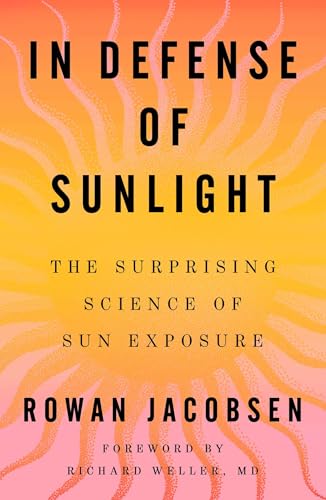
In Defense of Sunlight by Rowan Jacobsen

Book cover
In Defense of Sunlight
by Rowan Jacobsen


ISBN-13: 9780593197882
Hardcover: 288 pages
Publisher: Scribner
Released: June 16, 2026

Source: ebook review copy from the publisher through NetGalley.

Book Description, Modified from Goodreads:
A quiet revolution is transforming our understanding of sunlight’s effects on human health. For decades, a “zero-sun” policy has characterized our approach to sun protection, advising us to stay out of the sun whenever possible and apply sunscreen daily to any skin that might be exposed, rain or shine, summer or winter, indoors or out. But recent studies have proved that this policy is thoroughly mistaken and that this prolific misunderstanding is causing us to miss out on many of the health benefits of sun exposure.

In this incisive work, acclaimed journalist Rowan Jacobsen presents the growing case for the importance of modest sun exposure for our health and well-being. Aided by the most up-to-date studies on the effects of sunlight on human health, Jacobsen presents a much-needed, lucid assessment of not only what the sun can do for us, but how a lack of sun could actively be harming us.

In Defense of Sunlight sounds the call on what researchers have been sure of for years, and what health care providers and media outlets have been slow to take that sunlight is one of the simplest, and most equitable, treatments for a variety of health issues, from diabetes to dementia to multiple sclerosis. Laying out the new science of sunlight in a straightforward and responsible manner for mainstream readers, this book is an eye-opening story of scientific discovery, outlining not only best practices for sun exposure, but the story of how current recommendations became misguided, how a few inquisitive scientists glimpsed the truth and deciphered the mechanisms responsible, and how everyone can safely incorporate this new knowledge into their daily lives. It also exposes the implicit injustice underlying current approaches, which benefit the whitest people on earth (who are the most susceptible to skin cancer) at the expense of those with darker skin (who suffer extremely low rates of skin cancer and have the most to gain from sun exposure).

A call for a return to common sense in our relationship with our local star, In Defense of Sunlight offers its own seven words of Get sun. Not too much. Go outside.


My Review:
In Defense of Sunlight discussed scientific studies on the benefits and dangers of sunlight to human health using a historical framework. In the 1800s, scientists realized that lack of sunlight in badly polluted cities was causing rickets in children. Doctors started treating diseases like tuberculosis with sunlight, and the recommendations moved toward nude sunbathing for your health. Scientists discovered vitamin D. So, of course, people made vitamin D pills and UV lamps as health products but discovered neither quite lived up to hopes (though a narrow wavelength UV light can be used to treat multiple sclerosis!).

The author covered the skin cancer scare that lead to the current recommendations as well as the history of sunscreen, its variable effectiveness at blocking UV, and research into if it really does stop skin cancer. He also showed why the actual science is much more nuanced than 'everyone should always wear sunscreen.' You can get many health benefits from the sun while most sun-exposure cancers won't kill you, so informed sun exposure (especially for darker-skinned people) is desirable. After covering recent scientific studies on why getting sun on your skin provides various health benefits, he covered the latest science-based recommendations for how much sun your skin type should get and when is the best times to get it.

Though there is a lot of good scientific information in this book (thank you!), it's an easy read and the science is explained in terms a high schooler could understand. I knew I enjoyed the joint-deep warmth of the sun, and now I better understand why I'm drawn to sun exposure, especially in the morning. It helps your body in a multitude of ways. Overall, I'd highly recommend this informative and interesting book.


If you've read this book, what do you think about it? I'd be honored if you wrote your own opinion of the book in the comments.


Monday, June 30, 2025

A History of Women's Work by Janet Few

Book cover
A History of Women's Work
by Janet Few


ISBN-13: 9781036105266
Hardcover: 178 pages
Publisher: Pen and Sword History
Released: July 30, 2025

Source: ebook review copy from the publisher through NetGalley.

Book Description, Modified from Goodreads:
A History of Women's Work explores the often overlooked contributions of women throughout history, particularly in a patriarchal society where men have dominated the historical record. While men were more likely to leave traces – through wills, leases, and civic duties – women laboured behind the scenes, performing crucial yet unpaid tasks for their families and communities. In many households, women supported their husbands’ work, ran home-based industries, or sought paid employment despite societal restrictions.

This book delves into three main areas of women’s work: household tasks, home industries, and paid employment outside the home. Through case studies and practical research tips, it sheds light on the lives of these women, encouraging readers to uncover their own female ancestors' stories and contribute to a richer understanding of women’s history.


My Review:
A History of Women's Work is nonfiction about the different types of work that women did (primarily focused on England) up until the World Wars. The author covered keeping up the household to paid work that could be done at home to helping her husband or paid employment outside the home. The information was written in a very readable fashion, so even teens might find this interesting.

The author covered a variety of jobs, describing each one with some detail on how it was done, explaining how it changed over time, and sometimes using a real woman's example (as found in historical records) to show how the work affected their lives. Sometimes she pointed out a registry that you could go to if you're searching for details about your ancestors who did that job. She covered: making clothing, munitions work, domestic servants, straw plaiting, making matches, fishwives and herring packers, prostitution, housewives using herbal remedies, healing professions, cooking, glove making, dairy work, cleaning, laundry, lacemaking, midwifery, shop work, farm work during the World Wars, textile mills, button making, woman's suffrage, teaching, and pottery work. Overall, I'd recommend this interesting, informative nonfiction.


If you've read this book, what do you think about it? I'd be honored if you wrote your own opinion of the book in the comments.


Thursday, January 2, 2025

The Cure for Women by Lydia Reeder

Book cover
The Cure for Women
by Lydia Reeder


ISBN-13: 9781250284457
Hardcover: 336 pages
Publisher: St. Martin's Press
Released: December 3, 2024

Source: ebook review copy from the publisher through NetGalley.

Book Description, Modified from Goodreads:
After Elizabeth Blackwell became the first woman to graduate from medical school, more women demanded a chance to study medicine. Barred entrance to universities like Harvard, women built their own first-rate medical schools and hospitals. Their success spurred a chilling backlash from elite, white male physicians who were obsessed with eugenics and the propagation of the white race. Distorting Darwin’s evolution theory, these haughty physicians proclaimed in bestselling books that women should never be allowed to attend college or enter a profession because their menstrual cycles made them perpetually sick. Motherhood was their constitution and duty.

Into the midst of this turmoil marched tiny, dynamic Mary Putnam Jacobi, daughter of New York publisher George Palmer Putnam and the first woman to be accepted into the world-renowned Sorbonne medical school in Paris. As one of the best-educated doctors in the world, she returned to New York for the fight to prove the opposition wrong. Aided by other prominent women physicians and suffragists, Jacobi conducted the first-ever data-backed, scientific research on women's reproductive biology. The results of her studies shook the foundations of medical science and higher education. Full of larger than life characters and cinematically written, The Cure for Women documents the birth of a sexist science still haunting us today as the fight for control of women’s bodies and lives continues.


My Review:
The Cure for Women is about the first women doctors in America, the men who opposed them, and the fight for women to be accepted at male medical schools. It's more about what the author felt about the various people and events than quotes of what the women themselves said. The information about Mary Putnam Jacobi only took up about a third of the book. The book started by telling about the Blackwell sisters and a couple of other prominent women doctors, then we got into Mary's life. But the author tended to digress and give biographies and backstories for anyone new introduced into the story. For example, there's a chapter detailing a male doctor's 'rest cure' for women which also told details about several woman who took his cure, one dying afterward and the others finally breaking free of all male restraints to live healthy lives.

I hadn't expected so many biographies beyond Mary's and felt like they slowed the pacing and sometimes didn't even have to do with Mary's interesting story. Also, the author portrayed men as controlling, manipulative, childishly hateful, and basically willing to torture and subjugate women to achieve their own goals. She's convinced me that some of the main male opponents were pretty horrible people, but the supportive men were barely mentioned.

As Mary apparently published a lot of her research, and a number of the women doctors were the first to do things that other schools and hospitals later picked up, I'd expected more of a focus on what they accomplished. I was fascinated by Mary's innovative research showing that the menstrual cycle did not indicate that a woman was 'in heat' nor was it a sign of reoccurring weakness. Instead, this book was written as an epic battle between clever, independent women and white supremist males determined to force women back into a role of baby-making machines.


If you've read this book, what do you think about it? I'd be honored if you wrote your own opinion of the book in the comments.


Saturday, December 28, 2024

The Life and Times of Sherlock Holmes, Vol. 5 by Liese Sherwood-Fabre

book cover
The Life and Times of Sherlock Holmes
Volume Five
by Liese Sherwood-Fabre


ISBN-13: 9781952408366
ebook
Publisher: Little Elm Press, LLC
Released: December 15, 2024

Source: ebook review copy from the publisher through NetGalley.

Book Description, Modified from NetGalley:
Volume V of The Life and Times of Sherlock Holmes explores the cultural, scientific, and historical allusions found throughout Sir Arthur Conan Doyle’s famous detective stories. This collection of essays unpacks twenty-four topics mentioned in the original mysteries, from everyday details like hats and plumbing to complex issues such as international spying, the binomial theorem, and relations with Russia. Through such insights, readers gain a deeper understanding of the Victorian world in which Holmes operated.

Other essays explore both the familiar and the obscure, touching on subjects like the KKK’s presence in England, the significance of whaling, and legal concepts like insanity and blackmail. Unique cultural topics—such as the role of curry in the British Empire, the rise of bohemianism, and the Victorian obsession with rejuvenation through animal hormones—reveal the rich complexity of the era. The collection also features a bonus essay on Sarah Cushing from The Adventure of the Cardboard Box, offering fresh insight into one of the most sinister characters in the Canon.

The Life and Times of Sherlock Holmes provides a compelling lens through which readers gain a deeper understanding of the historical and social backdrop of the Holmes mysteries.


My Review:
The Life and Times of Sherlock Holmes is a collection of 24 short essays on the historical context of things mentioned in Sherlock Holmes stories. Each essay was inspired by a comment or incident in a Sherlock Holmes story, and we're told where the essay topic is mentioned. We're given a brief history or background information on the topic. The footnotes show that most of the information was found online, so you could look up much of this information for yourself if so motivated. Overall, this is an interesting and informative read.

Topics covered include types of hats, the binomial theorem, astronomy, plumber's smoke rockets and indoor plumbing, Ku Klux Klan, makeup, whaling industry, insurance policies, Bohemia, lunatic asylums, Russia, spices, hormone therapy (specifically with testosterone), suicide, crowns, spies, wax figures, Australia, counterfeiting, newspapers, domestic violence, Vaseline, blackmail, automata. Also included is an essay reprinted from 2028 on the character Sarah Cushing.


If you've read this book, what do you think about it? I'd be honored if you wrote your own opinion of the book in the comments.


Thursday, December 5, 2024

The Mysterious Case of the Victorian Female Detective by Sara Lodge

Book cover
The Mysterious Case of the Victorian Female Detective
by Sara Lodge


ISBN-13: 9780300277883
Hardcover: 384 pages
Publisher: Yale University Press
Released: November 5, 2024

Source: ebook review copy from the publisher through NetGalley.

Book Description from Goodreads:
From Wilkie Collins to the adventures of Sherlock Holmes, the traditional image of the Victorian detective is male. Few people realise that women detectives successfully investigated Victorian Britain, working both with the police and for private agencies, which they sometimes managed themselves.

Sara Lodge recovers these forgotten women’s lives. She also reveals the sensational role played by the fantasy female detective in Victorian melodrama and popular fiction, enthralling a public who relished the spectacle of a cross-dressing, fist-swinging heroine who got the better of love rats, burglars, and murderers alike.

How did the morally ambiguous work of real women detectives, sometimes paid to betray their fellow women, compare with the exploits of their fictional counterparts, who always save the day? Lodge’s book takes us into the murky underworld of Victorian society on both sides of the Atlantic, revealing the female detective as both an unacknowledged labourer and a feminist icon.


My Review:
The Mysterious Case of the Victorian Female Detective looks at both real and fictional female detectives in Victorian Britain. The author looked at specific examples of the female detective in fiction (both writing and theater) and commented on how these women reflected on the time period they were written in and how they were a commentary on their times, too. The author also examined real life examples of women who solved crimes or worked for private inquiry agencies or the official police force and how the reality contrasted with the fictional depictions.

While the book covered some details about the type of work these women really did, a lot of the book (especially near the end) was more commentary on the social context. This was interesting, but I was hoping for more information on what they really did--which, apparently, was often obscured by a tendency to glamorize the job to fit the fictional action heroine stereotype. Overall, I'd recommend this book to those who want to know more about women detectives in the mid- to late-1800s in Britain.


Tuesday, October 29, 2024

When Courage Calls by Sarah C. Williams

Book cover
When Courage Calls
by Sarah C. Williams


ISBN-13: 9781399803731
Kindle: 356 pages
Publisher: Hodder & Stoughton
Released: September 12, 2024

Source: ebook review copy from the publisher through NetGalley.

Book Description, Modified from Goodreads:
Millicent Fawcett, the leader of the British suffragist movement, described Josephine Butler as 'the most distinguished English woman of the nineteenth century'. Among the first feminist activists, Butler raised public awareness of the plight of destitute women, worked to address human trafficking and led a vigorous campaign to secure equal rights for women before the law.

Social historian Sarah C. Williams presents a re-examined biography of the radical political activist Josephine Butler. From the beauty of her childhood in Northumbria, to the stifling intellectual environment of mid-Victorian Oxford; from the impoverished streets of Liverpool and the brothels of London, Brussels and Paris, to the offices of Westminster and the Houses of Parliament. Butler's relentless drive to secure rights for women against the sexual double standard of her day captures a remarkable woman with deeply held values for equality.

Underpinning Butler's public life of political activism lies the full corpus of her writing and the spirituality that grounded her activism. When Courage Calls offers a profound examination of Butler's inner life of prayer, defined by her radical sense of justice that was able to transform Victorian society.

My Review:
When Courage Calls is a biography of Josephine Butler. I knew she'd done much to help women (especially children) trapped in prostitution. She was able to bring together people that normally wouldn't work together and even gathered support for similar work in Europe. I had expected much of the biography to be focused on the details of that work, and the book did cover some of that.

However, Josephine's faith played a motivating role in why she did what she did, so much of this book covered Josephine's Christian faith and the role she felt that prayer played in political activism. She wrote several books about other people, which we're told about and which provided several quotes that showed what she believed. There were also some quotes from various speeches she gave along with a summary of what she said and was trying to accomplish.

This biography was more of an overview of her life and beliefs rather than full of details and action. Perhaps those details no longer exist as Josephine refused to write about herself. Overall, I'd recommend this interesting biography.


If you've read this book, what do you think about it? I'd be honored if you wrote your own opinion of the book in the comments.


Saturday, August 3, 2024

Victorian Britain Day by Day by Nicholas Travers

Book cover
Victorian Britain Day
by Day by Nicholas Travers


ISBN-13: 9781399041751
Hardcover: 224 pages
Publisher: Pen and Sword History
Released: July 30, 2024

Source: ebook review copy from the publisher through NetGalley.

Book Description, Modified from Goodreads:
Victorian Britain Day by Day sheds new light on the most remarkable era in British history. Here is a tapestry of time, unpacked and uncovered from January 1st to December 31st, a rich mosaic of facts, events and tales, exploring the most extraordinary moments of the most extraordinary age.

Each day offers a different snapshot into our past, intermingling famous or renowned events, with rare, quirky and fun facts. What was the mysterious Sheep panic of 1888? Who was the notorious Spring heeled Jack? Why was William Gladstone run over by a cow? From the Great Exhibition, to the Industrial Revolution, Dickens and Darwin, Entertainment and Empire, the 19th century was an epoch of momentous political, cultural and social change. With meticulous research, Victorian Britain Day by Day covers every day of the year between 1837-1901.


My Review:
Victorian Britain Day by Day briefly describes significant events that occurred in Britain during 1837-1901. The format takes the reader through the year, one day at a time (January 1, January 2, etc.). The author lists several significant events that occurred on that day, indicating the year that they happened. If you like forming a timeline in your mind, this doesn't help: it's not easy to remember what order they're in or how they relate to each other (does one event lead to another?).

About half of the events focused on politics--forming governments, resignations, a few significant laws that were passed, things Victoria or her children did. There were birthdays, deaths, and weddings. Notable artists, writers, actors, scientists, and such usually got at least a mention of who they were on their birth date. Nothing was covered in detail, with weddings getting the most detailed descriptions. It's more a trivia type book than something you can easily use for research.


If you've read this book, what do you think about it? I'd be honored if you wrote your own opinion of the book in the comments.


Wednesday, March 20, 2024

The Real Anthony Fauci by Robert F. Kennedy Jr.

Book cover
The Real Anthony Fauci
by Robert F. Kennedy Jr.


ISBN-13: 978-1510766808
Hardcover: 492 pages
Publisher: Skyhorse Publishing
Released: November 16, 2021

Source: Bought.

Book Description, Modified from Goodreads:
Pharma-funded mainstream media has convinced millions of Americans that Dr. Anthony Fauci is a hero. Hands down, he is anything but.

As director of the National Institute of Allergy and Infectious Diseases (NIAID), Dr. Anthony Fauci dispenses $6.1 billion in annual taxpayer-provided funding for rigged scientific research, allowing him to dictate the subject, content, and outcome of scientific health research across the globe—truly a dark agenda. Fauci uses the financial clout at his disposal in a back handed manner to wield extraordinary influence over hospitals, universities, journals, and thousands of influential doctors and scientists—whose careers and institutions he has the power to ruin, advance, or reward in an authoritarian manner.

The Real Anthony Fauci reveals how “America’s Doctor” launched his career during the early AIDS crisis by partnering with pharmaceutical companies to sabotage safe and effective off-patent therapeutic treatments for AIDS. Fauci orchestrated fraudulent do-nothing studies, and then pressured US Food and Drug Administration (FDA) regulators into approving a deadly chemotherapy treatment he had good reason to know was worthless against AIDS. Fauci did the unthinkable and repeatedly violated federal laws to allow his Pharma partners to use impoverished and dark-skinned children as lab rats in beyond order, deadly experiments with toxic AIDS and cancer chemotherapies.

In early 2000, Fauci shook hands with Bill Gates in the library of Gates’ $147 million Seattle mansion, cementing a partnership that would aim to control an increasingly profitable $60 billion global vaccine enterprise with unlimited growth potential. Through funding leverage and carefully cultivated personal relationships with heads of state and leading media and social media institutions, the Pharma-Fauci-Gates alliance exercises dominion over global health policy and our beautiful country.

This is not just another political book. The Real Anthony Fauci details how Fauci, Gates, and their cohorts use their control of media outlets—both conservative and liberal leaning, scientific journals, key government and quasi-governmental agencies, global intelligence agencies, and influential scientists and physicians to flood the public with fearful propaganda about COVID-19 virulence and pathogenesis, and to muzzle debate and ruthlessly censor dissent.


My Review:
The Real Anthony Fauci describes how Fauci got control of a lot of taxpayer money to be used for medical research and used this to control what is researched and where and how that research is done. Anyone who uses a drug or shot created since the mid-1980s should read this as it's clear that the pharmaceutical companies are not being properly regulated. Their interests are being placed above the health of the taxpayers funding the studies. The author described how this has happened over time, and how poorly done drug trials have been covered up or even overlooked and the drugs approved here or for use in poor countries. It's truly sickening to realize how corruption has taken over the health agencies that were meant to help heal and protect us. I'd highly recommend this book to anyone wanting to make informed choices about their health.


If you've read this book, what do you think about it? I'd be honored if you wrote your own opinion of the book in the comments.


Saturday, November 4, 2023

The Worlds of Sherlock Holmes by Andrew Lycett

Book cover
The Worlds of Sherlock Holmes
by Andrew Lycett


ISBN-13: 9780711281677
Hardcover: 208 pages
Publisher: Frances Lincoln
Released: October 10, 2023

Source: ebook review copy from the publisher through NetGalley.

Book Description, Modified from Goodreads:
In this dive into the contemporary world of Holmes and Conan Doyle, biographer Andrew Lycett explores all that encompasses the world of the great detective – tracing the infamous character’s own interests, personality and mythologised biography alongside that of his creator’s. From the Victorian crazes for detection and séance, to contemporary developments in science and psychology, Lycett weaves together everything that inspired Conan Doyle in creating the world’s most famous detective and one of fiction's most enduring, enigmatic and recognisable characters .


My Review:
The Worlds of Sherlock Holmes is a biography of Conan Doyle and Sherlock Holmes, broken down by topic. The author started by covering the physical locations mentioned in the Sherlock Holmes stories, with a few details about and sometimes a picture of the real places. He also used illustrations taken from the stories. There were many quotes from the Holmes stories, so we often got more of what was in the book than new information about the place. We also got a bit about where Conan Doyle traveled during his life.

The next section focused on politics: mostly Doyle's views on current political issues during his life, but also how they were reflected in Holmes' views in the stories. The next section focused on science, starting with Darwin (evolution) and how that impacted Doyle's (and therefore Sherlock Holmes') views. The author also covered Holmes' scientific views and knowledge, as shown in the stories. Again, the focus seemed more on summarizing what the stories said about Holmes than comparing it to the real world forensics. The author also talked about Doyle's medical training and people that influenced his scientific views, some technological advances embraced by Doyle that weren't really mentioned in the stories, and Doyle's interest in the paranormal.

Next was about how crime was actually handled in the 1800s in England (as in, the founding of the police force and then the detective force), the emergence of crime fiction, Doyle's Sherlock Holmes stories and how he solved crimes, and how he inspired future crime fiction. Then the author covered how Holmes has been portrayed in films and plays. Next was about how The Strand Magazine (which published the Holmes stories) came into being and how the stories were later published as various types of books as literacy increased and printing costs decreased. The next section was about the art and music of the time period, especially that mentioned in the Holmes stories and a bit about Doyle's artistic relatives. Then he covered sports, especially those engaged in by Holmes or Doyle. The final section was about the enduring interest people have had in Holmes. I guess I expected more of a historical background for the stories than a biography of a fictional character and his author.


If you've read this book, what do you think about it? I'd be honored if you wrote your own opinion of the book in the comments.


Friday, July 14, 2023

"Cause Unknown" by Ed Dowd

Book cover
"Cause Unknown": The Epidemic of Sudden Deaths in 2021 & 2022
by Ed Dowd


ISBN-13: 9780593197882
Kindle ebook: 381 pages
Publisher: Skyhorse
Released: November 9, 2022

Source: ebook review copy from the publisher through NetGalley.

Book Description, Modified from Goodreads:
2020 saw a spike in deaths in America, smaller than you might imagine during a pandemic, some of which could be attributed to COVID and to initial treatment strategies that were not effective. But then, in 2021, the stats people expected went off the rails. The CEO of the OneAmerica insurance company publicly disclosed that during the third and fourth quarters of 2021, death in people of working age (18–64) was 40 percent higher than it was before the pandemic. Significantly, the majority of the deaths were not attributed to COVID.

A 40 percent increase in deaths is literally earth-shaking. Even a 10 percent increase in excess deaths would have been a 1-in-200-year event. But this was 40 percent.

It isn’t COVID, of course, because we know that COVID is not a significant cause of death in young people. Various stakeholders opine about what could be causing this epidemic of unexpected sudden deaths, but “CAUSE UNKNOWN” doesn’t opine or speculate but just presents the facts and let's you decide.

The book begins with a close look at the actual human reality behind the statistics, and when you see the people who are represented by the dry term Excess Mortality, it’s difficult to accept so many unexpected sudden deaths of young athletes, known to be the healthiest among us. Similarly, when lots of healthy teenagers and young adults die in their sleep without obvious reason, collapse and die on a family outing, or fall down dead while playing sports, that all by itself raises an immediate public health concern. Or at least it used to.

Do you recall seeing these kinds of things occurring during your own life—in junior high? In high school? In college? How many times in your life did you hear of a performer dropping dead on stage in mid-performance? Your own life experience and intuition will tell you that what you’re about to see is not normal. Or at least it wasn’t normal before 2021.


My Review:
"Cause Unknown" focused on the sudden increase in non-COVID deaths that are creating a large rise in Excess Mortality. The author included many pages showing newspaper headlines about healthy young people dying suddenly. These included a web link and QR code so you can go read these articles yourself. Every time something is cited, there's a link so you can read the paper or article or look at the government statistics to make sure the information wasn't taken out of context.

The author mainly looked at young athletes (how often did they used to die versus in 2021 and 2022), young people dying in their sleep, younger medical professionals and famous people dying suddenly. He also looked at when the COVID shots were mandated compared to when the sudden deaths increased, the USA government's Vaccine Adverse Event Reporting Systems for the COVID shots compared to previous vaccines, how other countries have stopped giving the shots to young people, and how disability claims have gone up. The data is convincing that we need to do something about this rather than just pretending it's not happening. I'd recommend this book to everyone.


If you've read this book, what do you think about it? I'd be honored if you wrote your own opinion of the book in the comments.


Excerpt: Read an excerpt using Google Preview.

Monday, May 15, 2023

Living in Early Victorian London by Michael Alpert

Book cover
Living in Early Victorian London
by Michael Alpert


ISBN-13: 9781399060844
Hardcover: 224 pages
Publisher: Pen and Sword History
Released: April 30, 2023

Source: ebook review copy from the publisher through NetGalley.

Book Description, Modified from Goodreads:
London in the 1840s was sprawling and smoke-filled, a city of extreme wealth and abject poverty. Some streets were elegant with brilliantly gas-lit shop windows full of expensive items, while others were narrow, fetid, muddy, and in many cases foul with refuse and human filth. Railways, stations and sidings were devouring whole districts and creating acres of slums or ‘rookeries’ into which the poor of the city were jammed and where crime, disease and prostitution were rife.

The most sensational crime of the epoch, the murder of Patrick O’Connor by Frederick and Maria Manning, filled the press in the summer and autumn of 1849. Michael Alpert uses the trial record of this murder, accompanied by numerous other contemporary sources, among them journalism, diaries and fiction, to show how day-to-day lives, birth, death, sickness, work, shopping, cooking, and buying clothes, were lived in the crowded, noisy capital in the early decades of Victoria’s reign. These sources illustrate how ordinary people lived in London, their incomes, entertainments, religious practice, reading and education, their hopes and anxieties. Life in Early Victorian London reveals how ordinary people like the Mannings and thousands of others experienced their multifaceted lives in the capital.

Early Victorian London lived on the cusp of great improvements, but it was a city which in some aspects was mediaeval. Its inhabitants enjoyed the benefit of the Penny Post and the omnibus, and they were protected to some extent by a police force. The Mannings fled their crime on the railway, were trapped by the recently-invented telegraph and arrested by ‘detectives’ (a new concept and word), but they were hanged in public as murderers had been for centuries, watched by a baying, drunken and swearing mob.


My Review:
Living in Early Victorian London described life in London between 1837 and the early 1850s. The author started by using journals and articles from the time to describe London, from the docks to the richer areas to the slums. The book was loosely organized around the trial records of a certain murder. Some of the details about dress, food, furnishings, etc. come from court trial records, but also newspaper ads, diaries, and fiction written at the time. The book covered a wide variety of topics and included details about things like how much different jobs might earn compared to how much certain items cost. It covered things like what types of food or housing a poor laborer could afford compared to the middle class, second-hand clothing, sanitary conditions and sickness, the mail system, transportation, education, police, crime, and trials.

It's full of interesting information, but I sometimes felt like I'd need to use a search function to find things in the future since the author tended to jump around within a chapter. Overall, I'd recommend this book to those wanting details about London for novel research or those just plain curious.


If you've read this book, what do you think about it? I'd be honored if you wrote your own opinion of the book in the comments.


Excerpt: Read an excerpt using Google Preview.

Monday, December 12, 2022

The Life and Times of Sherlock Holmes, Volume 4 by Liese Sherwood-Fabre

book cover
The Life and Times of Sherlock Holmes
Volume Four
by Liese Sherwood-Fabre


ISBN-13: 9781952408205
ebook: 196 pages
Publisher: Little Elm Press, LLC
Released: December 6th 2022

Source: ebook review copy from the publisher through NetGalley.

Book Description, Modified from NetGalley:
Arthur Conan Doyle's original tales include many references to everyday Victorian life that are no longer part of current readers’ world. What Holmes would have eaten from a can while searching for the hound of the Baskervilles, Watson's enjoyment of a yellow-back novel, or the proper use of a gasogene would have been common knowledge to the Victorian contemporary but compels modern readers to run to the nearest reference book. These twenty-four short essays pull such items from the past and expand on their significance in the story. As an additional bonus, this book contains an essay on the role of scandal in Holmes' cases. After enjoying these concise treatises on Holmes’ world, readers will have a deeper understanding and appreciation of both the times and the life of the world’s greatest consulting detective.

Topics covered include: The Pinkerton Agency, Victorian Firearms, Handcuffs, Gossip, Canning, Collecting, Ears, Stocks and Bonds, Yellow Paperbacks, Opium Dens, Handkerchiefs, Plaster of Paris, Seltzer Water and Gasogenes, Voodoo, Curare, Cocaine and Other Addictions, Freemasonry, Tweed, Leprosy, Whist, Homelessness, Chemistry, The London Underground, and Scandal in the Canon.


My Review:
The Life and Times of Sherlock Holmes is a collection of 24 short essays on the historical context of things mentioned in Sherlock Holmes stories. Each essay was inspired by a comment or incident in a Sherlock Holmes story, and we're told where the essay topic is mentioned. We're given a brief history or background information on the topic. The footnotes show that most of the information was found online or in a small number of books about Victorian England, so you could look up much of this information for yourself if so motivated. However, it is an interesting and informative read.

Topics covered include The Pinkerton Agency, Victorian Firearms, Handcuffs, Gossip, Canning, Collecting, Ears, Stocks and Bonds, Yellow Paperbacks, Opium Dens, Handkerchiefs, Plaster of Paris, Seltzer Water and Gasogenes, Voodoo, Curare, Cocaine and Other Addictions, Freemasonry, Tweed, Leprosy, Whist, Homelessness, Chemistry, The London Underground, and Scandal.


If you've read this book, what do you think about it? I'd be honored if you wrote your own opinion of the book in the comments.


Saturday, September 10, 2022

Victorian Fashions for Women by Fiona Kay, Neil R Storey

Book cover
Victorian Fashions for Women
by Fiona Kay, Neil R Storey


ISBN-13: 9781399004169
Hardcover: 248 pages
Publisher: Pen & Sword History
Released: Aug. 9, 2022

Source: ebook review copy from the publisher through NetGalley.

Book Description, Modified from Goodreads:
Victorian Fashions for Women explores the British styles and clothing throughout the long reign of Queen Victoria, from the late 1830s to the first years of the 20th century. Within are a superb overview of the dresses, hats, hair styles, corsetry, undergarments shoes and boots that combined to present the prevailing styles for each decade. From those who had enough money to have day and evening wear and clothes for sports and outdoor activities, to those with limited income and wardrobes or labouring folk with little more than the clothes they stood up in.

All decades are illustrated with original photographs, adverts and contemporary magazine features from the authors' own remarkable collections, accompanied by a knowledgeable and informative text that describes the fashions, their social history context and influences reflected in the clothes of the time. Laid out in a clear and easy-to-follow chronological order, the key features of styles, decoration and accoutrements will help family historians to date family photographs and will provide a useful resource for students and costume historians or for anyone with a love of fashion and style to enjoy.


My Review:
Victorian Fashions for Women describes the changing fashions in women's clothing in England from 1840 to 1900. It's actually throughout Queen Victoria's reign, but the authors took each decade at a time so it ended up titled as "The 1840s Look" and so on. The authors described what fashionable women were wearing and used some quotes from fashion magazines, newspapers reporting on what the royals wore, and even ads. I'd hoped for a lot of pictures or illustrations, but it was basically a lot of technical terms (fabric names, sewing and clothing terms) that I sometimes found hard to follow as I didn't know what many of the terms meant. Only afterward, I discovered a glossary of terms at the back, though even that wasn't as helpful as I'd hoped.

Anyway, the authors focused on changes over time to the overall look, the sleeves, waist, where the bulk of the skirt went, trimmings, the underclothing used to get the right look, outerwear (hats, cloaks, etc.), and trends in jewelry. They also talked about how changes in technology (like new dyes) changed fashions. In the last chapter, the authors covered things like prison warden uniforms and mourning attire. This book is helpful if you mainly want to know what fashion trends were popular at a certain time (big skirts, big sleeves, etc.) but it's less helpful if you want a visual guide or a non-technical description of real dresses in real situations rather than the suggested high fashions.


If you've read this book, what do you think about it? I'd be honored if you wrote your own opinion of the book in the comments.


Tuesday, February 1, 2022

A Taste for Poison by Neil Bradbury

Book cover
A Taste for Poison
by Neil Bradbury


ISBN-13: 9781250270757
Hardcover: 304 pages
Publisher: St. Martin's Press
Released: February 1st 2022

Source: ebook review copy from the publisher through NetGalley.

Book Description from Goodreads:
As any reader of murder mysteries can tell you, poison is one of the most enduring—and popular—weapons of choice for a scheming murderer. It can be slipped into a drink, smeared onto the tip of an arrow or the handle of a door, even filtered through the air we breathe. But how exactly do these poisons work to break our bodies down, and what can we learn from the damage they inflict?

In a fascinating blend of popular science, medical history, and true crime, Dr. Neil Bradbury explores this most morbidly captivating method of murder from a cellular level. Alongside real-life accounts of murderers and their crimes—some notorious, some forgotten, some still unsolved—are the equally compelling stories of the poisons involved: eleven molecules of death that work their way through the human body and, paradoxically, illuminate the way in which our bodies function.

Drawn from historical records and current news headlines, A Taste for Poison weaves together the tales of spurned lovers, shady scientists, medical professionals and political assassins to show how the precise systems of the body can be impaired to lethal effect through the use of poison. From the deadly origins of the gin & tonic cocktail to the arsenic-laced wallpaper in Napoleon’s bedroom, A Taste for Poison leads readers on a fascinating tour of the intricate, complex systems that keep us alive—or don’t.


My Review:
A Taste for Poison explored how eleven different poisons work on the body. The author covered poisonings using insulin, belladonna, morphine, strychnine, ricin, aconite, cyanide, potassium, polonium-210, arsenic, and chlorine. He told about one or more cases that used the poison, then described the symptoms, how it could be treated if caught in time, and the biological details about how the poison disrupts the normal functioning of the body to create the symptoms and death. Most of the murders were from the mid-1800s to modern day, with a focus on relatively recent cases in England and America. The cases were told briefly but in an interesting way. The biochemistry details were easy to follow, with enough detail to follow what goes wrong without getting too bogged down in the science. Overall, I'd recommend this interesting book.


If you've read this book, what do you think about it? I'd be honored if you wrote your own opinion of the book in the comments.


Monday, January 31, 2022

Tea by Kevin Gascoyne

Book cover
Tea by Kevin Gascoyne,
François Marchand,
Jasmin Desharnais,
Hugo Americi,
Jonathan Racine


ISBN-13: 9780593197882
Paperback: 271 pages
Publisher: Firefly Books
Released: November 3rd 2011

Source: ebook review copy from the publisher through NetGalley.

Book Description, Modified from Goodreads:
Tea is a comprehensive guide to non-herbal tea, the plant Camellia sinensis. Concise and authoritative text and an abundance of color photographs take the reader on an escorted tour of the world's tea-growing countries: China, Japan, Taiwan, India, Sri Lanka, Nepal, Vietnam and East Africa. Like a fine wine, it is the "terroir" -- a region's soil and climate -- that imparts unique characteristics to a tea. The book covers black, green, white, yellow, oolong, pu'er, perfumed, aromatic and smoked teas.

Topics include an overview of the history of tea, tea varieties, the worldwide export of tea, how tea is processed, signature tea cultivars, the art of making, serving and tasting tea, including tea ceremonies, and tea in cooking with 15 recipes. Also, a set of detailed charts, tables and graphs shows the caffeine, antioxidant and other biochemical properties of 35 teas.


My Review:
Tea provides a detailed look at the history and present state of tea in China, Japan, Taiwan, India (and, briefly, Sri Lanka, Nepal, Vietnam and East Africa). The book started by providing an overview of the history of tea and information about the different tea types: black, green, white, yellow, oolong, pu'er, perfumed, aromatic, and smoked teas. The authors then focused on specific countries and talked about where the tea is grow, how the weather affects the tea taste, the tea types that they grow there, if the tea is primarily for domestic use or export, and details about how they process the tea and about local tea drinking ceremonies. They ended with 15 recipes that use tea and some scientific analysis about what levels of caffeine and antioxidants are in various teas and how different preparation methods (steeping times, multiple infussions, etc.) affect the amounts of caffeine and antioxidant in each cup of tea. If you really like your tea and want to learn the details, this book has a lot for detailed information.


If you've read this book, what do you think about it? I'd be honored if you wrote your own opinion of the book in the comments.


Sunday, October 3, 2021

Encyclopedia of the Ordinary Things by Stepanka Sekaninova

Book cover
Encyclopedia of the Ordinary Things
by Stepanka Sekaninova


ISBN-13: 9788000061283
Hardcover: 96 pages
Publisher: Albatros Media
Released: October 5th 2021

Source: ebook review copy from the publisher through NetGalley.

Book Description, Modified from Goodreads:
We use them daily, pass them by, and it never occurs to us to stop and think about where they came from. Shoes, umbrellas, toothbrushes, toothpicks, socks, dolls, and so on and so forth. How did they come to be? Who invented them? How did they develop and change over time?


My Review:
Encyclopedia of the Ordinary Things is about the history of ten common items and is targeted at ages 6-12 years old. The author covered skates, umbrellas, glasses, dolls, perfume, horse toys, toilets, toothbrushes, beds, and tights. Each item had several pages describing how the item changed throughout history and appeared in different cultures. It's not a lot of information, though, since illustrations took up half of the page space. These illustrations were stylistic rather than highly accurate. Each section concluded with two pages of related items, usually focusing on the inventor of the item (Velcro, zippers, skies, etc.). These were very brief so that several items would fit on each page.

I was disappointed that the author put in speculation when I would have preferred facts. For example, when explaining: "The soles of some prehistoric shoes were made from bear skin....Our ancestors believed that bear skin would give them the strength of the feared animal and protect them." How do we know what they believed? We don't. Prehistory means they didn't leave writing saying this. It's just a guess. I felt like it was misleading to call this book an encyclopedia due to how few items were covered, the speculation included, and the stylistic illustrations. The items weren't even listed in alphabetical order. If you just want a brief overview on these objects, though, it did have some interesting trivia.


If you've read this book, what do you think about it? I'd be honored if you wrote your own opinion of the book in the comments.


Tuesday, September 28, 2021

The Story of the Country House by Clive Aslet

Book cover
The Story of the Country House
by Clive Aslet


ISBN-13: 9780300255058
Hardcover: 256 pages
Publisher: Yale University Press
Released: September 28th 2021

Source: ebook review copy from the publisher through NetGalley.

Book Description, Modified from Goodreads:
The Story of the Country House is an authoritative and vivid account of the British country house, exploring how they have evolved with the changing political and economic landscape. Clive Aslet reveals the captivating stories behind individual houses, their architects, and occupants, and paints a vivid picture of the wider context in which the country house in Britain flourished and subsequently fell into decline before enjoying a renaissance in the twenty-first century.

The genesis, style, and purpose of architectural masterpieces such as Hardwick Hall, Hatfield House, and Chatsworth are explored, alongside the numerous country houses lost to war and economic decline. We also meet a cavalcade of characters, owners with all their dynastic obsessions and diverse sources of wealth, and architects such as Inigo Jones, Sir John Vanbrugh, Robert Adam, Sir John Soane and A.W.N. Pugin, who dazzled or in some cases outraged their contemporaries.


My Review:
The Story of the Country House talked about the changes in the British country house (as found throughout the United Kingdom) from the Roman villa and Medieval manor house to modern times. The author broke the subject into time periods and talked about the social customs and developing technologies that influenced the layout and look of the houses. He talked about the people who built country houses (the owners and the architects) and about specific houses (including a picture, usually of the outside). He also talked about the different architectural styles and briefly about trends in landscaping styles, location selection, house size, etc. I'd recommend this book to those interested in the people who built and wider social context of British country houses.


If you've read this book, what do you think about it? I'd be honored if you wrote your own opinion of the book in the comments.


Monday, July 19, 2021

A Mudlark's Treasures by Ted Sandling

Book cover
A Mudlark's Treasures
by Ted Sandling


ISBN-13: 9780593197882
Paperback: 208 pages
Publisher: Aurum Press
Released: June 22nd 2021

Source: review copy from the publisher through Amazon Vine.

Book Description, Modified from Goodreads:
Mudlarking, the act of searching the Thames foreshore for items of value, has a long tradition in England's capital. In the late 18th and 19th centuries, mudlarks were small boys grubbing a living from scrap. Today’s mudlarks unearth relics of the past from the banks of the Thames which tell stories of Londoners throughout history. From Roman tiles to elegant Georgian pottery, presented here are modern-day mudlark Ted Sandling's most evocative finds, gorgeously photographed. Together they create a mosaic of everyday London life through the centuries, touching on the journeys, pleasures, vices, industries, adornments and comforts of a world city. This unique and stunning book celebrates the beauty of small things, and makes sense of the intangible connection that found objects give us to the individuals who lost them.


My Review:
A Mudlark's Treasures is about the types of things that can be found on the banks of the Thames, specifically the finds that the author has made. These objects span a long period of time, from before the founding of London to nearly present day. He focused on historical objects. After an introduction describing what mudlarking was in the past and is in the present, he talked about his finds. He put them in groupings of similar types. He briefly described the object found and then gave about a page and a half of information about it and when it was made. The only pictures were those on the cover, and they were small and not very high definition. Numbers labeled what they were and when they were made, and these were later described in the book. However, these were only about half of the total finds that he talked about. Part of the reason I got the book was because I was interested in actually seeing what these objects look like (even in a broken state), so I was disappointed. However, I did enjoy learning the history behind these objects.


If you've read this book, what do you think about it? I'd be honored if you wrote your own opinion of the book in the comments.


Monday, April 19, 2021

How Our Ancestors Died by Dr Simon Wills

Book cover
How Our Ancestors Died
by Dr Simon Wills


ISBN-13: 9781781590386
Paperback: 240 pages
Publisher: Pen & Sword Family History
Released: January 19th 2014

Source: ebook review copy from the publisher through NetGalley.

Book Description, Modified from Goodreads:
What were the principal causes of death in the past? Could your ancestor have been affected? How was disease investigated and treated and what did our ancestors think about the illnesses and the accidents that might befall them? Simon Wills fascinating survey of the diseases that had an impact on their lives seeks to answer these questions. His graphic, detailed account offers an unusual and informative view of the threats that our ancestors lived with and died of. He describes the common causes of death - cancer, cholera, dysentery, influenza, malaria, scurvy, smallpox, stroke, tuberculosis, typhus, yellow fever, venereal disease and the afflictions of old age. Alcoholism is included, as are childbirth and childhood infections, heart disease, mental illness and dementia. Accidents feature prominently road and rail accidents, accidents at work and death through addiction and abuse is covered as well as death through violence and war.

Simon Wills work reveals how life and death have changed over the centuries, how medical science has advanced so that some once-mortal illnesses are now curable while others are just as deadly now as they were then. In addition to describing causes of death and setting them in the context of the times, his book shows readers how to find and interpret patient records, death certificates and other documents in order to gain an accurate impression of how their ancestors died.


My Review:
How Our Ancestors Died explains how to find out how your British ancestors died and what the various medical terms mean. The focus seemed mostly on the late 1700s to modern day, though he did comment on occurrences (of plague, etc.) further back in history. The author started by explaining the basic medical practices of the time and how to find death reports. He then talked about specific, common ways that people died, including basic information about the disease or examples of common fatal accidents as well as explaining the words that were used to describe that disease at the time. He covered accidents, childhood diseases, cholera, chest infections, bowel infections, influenza, plague, smallpox, tropical diseases, tuberculosis, typhus, venereal disease, heart problems, epilepsy, stroke, war, wounds, childbirth, suicide, scurvy, execution, murder, starvation, food poisoning, other poisoning, and more. He also talked about historical problems like dietary deficiencies, alcoholism, mental illness, pregnancy, etc. This book contained useful information on finding out how your ancestors died: both where to look for documentation and for understanding what's on the documents.


If you've read this book, what do you think about it? I'd be honored if you wrote your own opinion of the book in the comments.


Excerpt: Read an excerpt using Google Preview.

Tuesday, April 6, 2021

Castle Builders by Malcolm Hislop

Book cover
Castle Builders
by Malcolm Hislop


ISBN-13: 9781526796615
Paperback: 272 pages
Publisher: Pen and Sword Archaeology
Released: April 30th 2021


Source: ebook review copy from the publisher through NetGalley.

Book Description, Modified from Goodreads:
In Castle Builders, Malcolm Hislop looks at the hugely popular subject of castles from the unusual perspective of design and construction. We discover something of the personalities behind their creation - the architects and craftsmen - and, furthermore, the techniques they employed, and how style and technology was disseminated. Castle Builders takes both a thematic and a chronological approach to the design and construction of castles, providing the reader with clear lines of development. Themes include earth, timber and stone construction techniques, the evolution of the great tower, the development of military engineering, the progression of domestic accommodation, and the degree to which aesthetics contributed to castle design.


My Review:
Castle Builders is a detailed look at the archaeological evidence for how castles were built in Great Britian, from manors on raised earthworks to carpentry walls, floors, and roofs, to masonry fortification, buildings, and plumbing issues. The author spent a lot of time providing details, from the exact dimensions of the moats to the name of the engineer that headed the building project to the apparent spread and development of different architectural features based on when different castles were built. Some pictures of the described features were included and were very interesting, illustrating his points. If you want to know the layers of subsoil found mounded next to the moat and the implications for how both were created, you'll find that information in this book. Architectural and castle-related terms were rarely defined in the text, though there's a glossary in the back. However, this is probably too detailed to be of interest if you don't know the basic terms already. While the book provided a great deal of information and analysis, it's probably too technical to interest someone with only a casual interest in castles.


If you've read this book, what do you think about it? I'd be honored if you wrote your own opinion of the book in the comments.


Excerpt: Read an excerpt using Google Preview.