Showing posts with label military. Show all posts

Tuesday, April 4, 2017

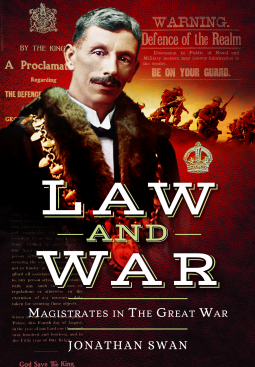
Law and War by Jonathan Swan

book cover
Law and War
by Jonathan Swan


ISBN-13: 9781473853379
Hardcover: 272 pages
Publisher: Pen & Sword
Released: March 30, 2017

Source: ebook review copy from the publisher through NetGalley.

Book Description, Modified from NetGalley:
Within days of the outbreak of hostilities of the Great War, the English government introduced the Defence of the Realm Act. With several amendments over the years, this all-encompassing legislation resulted in the creation of hundreds of subsidiary regulations, many of which affected the lives of ordinary people in a way they had never expected.

Many, including the magistrates themselves, fell foul of the myriad orders, covering billeting, licensing, lighting and rationing, which were enforced by the new special constables. At the same time, the conscription of the criminal classes saw a huge fall in the normal workload of the courts and the closure of many prisons.

The magistrates responded as best they could. Some magistrates went to war; some lost their lives. Others served in the many voluntary organisations and committees that appeared across the country, such as the Military Service Tribunals or the Volunteer Corps.

The end of the war saw a further change to the old order when the first women magistrates were appointed, marking the birth of modern magistracy.


My Review:
Law and War looked at the many challenges faced by England's magistrates during the Great War as many new laws--often poorly worded or not well thought out--were put into affect. The author explained how things worked before the war and then during the war. He included a detailed overview of how the legal system worked prior to the war, which I found especially useful since I'm not from England.

The author quoted the laws (in part or in full) and described some court cases showing how people accidentally or deliberately broke those laws. He talked about military law and martial law, the Defense of the Realm Act, laws about billeting, enemy aliens, drunkenness and alcohol, lights showing at night, enlistment and exemptions, desertion and absent without leave, food prices and rationing, and laws specifically affecting women and children. He also briefly talked about fraud, special constables, and a few other issues.

I thought the book was going to be more about how the role of magistrate changed because of the war, and he did cover this. However, most of the book looked at the laws that were passed and how they affected people. The information was interesting, so I'd recommend this book to people interested in this aspect of WWI.


If you've read this book, what do you think about it? I'd be honored if you wrote your own opinion of the book in the comments.


Thursday, December 15, 2016

Tough As They Come by Travis Mills

book cover
Tough As They Come
by Travis Mills,
Marcus Brotherton


ISBN-13: 9781101904787
Hardcover: 256 pages
Publisher: Convergent Books
Released: Oct. 27, 2015

Source: Review copy from the publisher through Amazon Vine.

Book Description, Modified from Goodreads:
Thousands of soldiers die year to defend their country. United States Army Staff Sergeant Travis Mills was sure that he would become another statistic when, during his third tour of duty in Afghanistan, he was caught in an IED blast four days before his twenty-fifth birthday. Against the odds, he lived, but at a severe cost—Travis became one of only five soldiers from the wars in Afghanistan and Iraq to survive a quadruple amputation.

Suddenly forced to reconcile with the fact that he no longer had arms or legs, Travis was faced with a future drastically different from the one he had imagined for himself. He struggled through the painful and anxious days of rehabilitation so that he could regain the strength to live his life to the fullest. With enormous willpower and endurance, the unconditional love of his family, and a generous amount of faith, Travis shocked everyone with his remarkable recovery. Even without limbs, he still swims, dances with his wife, rides mountain bikes, and drives his daughter to school.


My Review:
Tough As They Come is a memoir. The first two-thirds of the book described Travis Mill's childhood and 3 deployments in Afghanistan. He describes daily life and some of the action he took part in. He doesn't "talk technical," so his story is easy to follow and to get a sense of what it's like.

The last third of the book talked about the IED blast and his recovery. From the book description, I'd expected most of the book to be about his recovery, but he's not the type of guy to dwell on the past. It's part of the reason he's doing so well. He's also always up for a challenge, has a positive attitude, and has the support of a loving family. He gave enough details that you can understand what he and his family went through and how they made it through. To give an idea of what Travis is like, here's a quote (from an ARC, so the final version might be different) from page 246:

"Hard times come to everybody. When hard times happen, we have a choice to make. We can become discouraged and bitter, or we can choose to never quit. When life gets hard, the key is just to keep pushing forward. Instead of saying, "It could be worse," the key is to say, "It's going to get better." Then work with all your might toward that goal."


If you've read this book, what do you think about it? I'd be honored if you wrote your own opinion of the book in the comments.


Tuesday, June 2, 2015

Men of War by Alexander Rose

book cover
Men of War:
The American Soldier in Combat at Bunker Hill, Gettysburg, and Iwo Jima
by Alexander Rose


ISBN-13: 9780553805185
Hardcover: 496 pages
Publisher: Random House
Released: June 2, 2015

Source: Review copy from the publisher through Amazon Vine.

Book Description, Modified from Amazon:
In the grand tradition of John Keegan’s enduring classic The Face of Battle comes a searing, unforgettable chronicle of war through the eyes of the American soldiers who fought in three of our most iconic battles: Bunker Hill, Gettysburg, and Iwo Jima. This is not a book about how great generals won their battles, nor is it a study in grand strategy. Men of War is instead a riveting, visceral look at ordinary soldiers under fire.

Drawing on an immense range of firsthand sources from the battlefield, Rose begins by re-creating the lost and alien world of eighteenth-century warfare at Bunker Hill, the bloodiest clash of the War of Independence—and reveals why the American militiamen were so lethally effective against the oncoming waves of British troops. Then, focusing on Gettysburg, Rose describes a typical Civil War infantry action, vividly explaining what Union and Confederate soldiers experienced before, during, and after combat. Finally, he shows how in 1945 the Marine Corps hurled itself with the greatest possible violence at the island of Iwo Jima, where nearly a third of all Marines killed in World War II would die.

To an unprecedented degree, Men of War brings home the reality of combat and, just as important, its aftermath in the form of the psychological and medical effects on veterans.


My Review:
"Men of War" details what battle was like for soldiers at Bunker Hill, Gettysburg, and Iwo Jima. The book came across as extensively researched, and the author quoted from many diaries and letters written by those who actually lived through these battles. He gave an overview of the battle then went into detail about what weapons the soldiers had, what damage those weapons did, what the battle experience was at various locations or in various situations (like for the defending infantry and for the attacking infantry), what the experience of the wounded was like (including the medical care of the time), and how they coped after the battle. Though I understand why the author included this level of detail, I could have lived with a "the mortar pulverized the body" description rather than the graphic, detailed blood-and-guts version we got. This was not a book I could read before going to sleep.

I felt that the author gave a balanced view of the battles and tried to present the attitudes they had toward the experience of battle at each time period rather than imposing our modern views on them. I freely grant that I haven't read every battle book out there, but this is the first time I've read a good, reasonable explanation for why the British acted as they did at Bunker Hill.

Overall, I found this book very worth the time of reading it. And it's dense, so it took some time. I'd recommend this informative book to anyone interested in what the experience of battle was like in these battles.

If you've read this book, what do you think about it? I'd be honored if you wrote your own opinion of the book in the comments.


Thursday, January 1, 2015

The Last Rescue by Howard Wasdin

book cover
The Last Rescue
by Howard Wasdin
with Joel Kilpatrick


ISBN-13: 9781595555946
Hardcover: 288 pages
Publisher: Thomas Nelson
Released: October 28, 2014

Source: Review copy from the publisher through BookLook.

Book Description, Modified from Back Cover:
As a Navy SEAL, Howard Wasdin survived the firestorm made famous in "Black Hawk Down" only to return to a world without support, without a mission, and soon without his family. Wounded in Mogadishu and facing a torturous journey of rehabilitation and recovery, he came home to find his marriage falling apart and his world upended. Then he met Debbie, an accountant emerging from her own trial by fire.

"The Last Rescue" is an unforgettable tale of brokenness and healing, going deep into the firing line of modern warfare, through the agony of broken marriages, and onto a path of redemption and love. With a clear-eyed view of the inevitability of heartache and the power of God's faithfulness, Howard and Debbie remind us that no matter what our circumstances, we should never, ever, give up hope.


My Review:
The Last Rescue is a memoir. Howard is the main viewpoint of the story, but Debbie gives her viewpoint of events at several points. Howard talked about his childhood and his injury in war to explain where he was coming from, but most of the book was about what happened when he returned: his recovery from his injury, his marriages, his attempts to make a living off his military skills, and finally choosing a new career--and life--path.

He was very open about admitting the ways that he was at fault in various relationship breakdowns and why he was acting that way. It was interesting to see his attitude changing from desperately wanting a loving family situation and needing to hold on to his "rock star" warrior status to slowly learning how to be a part of creating that loving, supportive family situation he craved and moving on to a new career path.

Though "rediscovering their faith in God" is in the book description, they didn't say much about their religious journey. The references were mainly about him feeling that God worked events in his life to bring healing and fulfillment and why he felt God had kept him alive. This book might interest returning war veterans who are having trouble readjusting as Howard has "been there, done that."


If you've read this book, what do you think about it? I'd be honored if you wrote your own opinion of the book in the comments.


Monday, January 27, 2014

Reconstructing Ancient Linen Body Armor by Gregory S. Aldrete

This is another review done as a member of Amazon Vine, so I'm posting a description of the book with a direct link to my review on Amazon.

book cover
Reconstructing Ancient Linen Body Armor
by Gregory S. Aldrete


ISBN-13: 9781421408194
Hardcover: 304 pages
Publisher: Johns Hopkins University Press
Released: March 1, 2013

Book Description, Modified from Back Cover:
Alexander the Great led one of the most successful armies in history and conquered nearly the entirety of the known world while wearing armor made of cloth. How is that possible?

An extensive multiyear project in experimental archaeology, this pioneering study presents a thorough investigation of the linothorax, linen armor worn by the Greeks, Macedonians, and other ancient Mediterranean warriors. Because the linothorax was made of cloth, no examples of it have survived. Combining traditional textual and archaeological analysis with hands-on reconstruction and experimentation, the authors unravel the mysteries surrounding the linothorax. They have collected and examined all of the literary, visual, historical, and archaeological evidence for the armor and detail their efforts to replicate the armor using materials and techniques that are as close as possible to those employed in antiquity.

By reconstructing actual examples using authentic materials, the authors were able to scientifically assess the true qualities of linen armor for the first time in 1,500 years. The tests reveal that the linothorax provided surprisingly effective protection for ancient warriors, that it had several advantages over bronze armor, and that it even shared qualities with modern-day Kevlar.

My Review: Link to my review on Amazon.

Tuesday, September 25, 2012

The Axmann Conspiracy by Scott Andrew Selby

book cover
The Axmann Conspiracy
by Scott Andrew Selby


ISBN-13: 9780425252703
Hardcover: 320 pages
Publisher: Berkley Hardcover
Released: September 4, 2012

Source: Review copy from the publisher.

Book Description from Back Cover:
A trusted member of Hitler’s inner circle, Artur Axmann, the head of the Hitler Youth, witnessed the Führer commit suicide in Berlin—but he would not let the Reich die with its leader. Evading capture, and with access to remnants of the regime’s wealth, Axmann had enough followers to reestablish the Nazi party in the very heart of Allied-occupied Germany—and position himself to become dictator of the Fourth Reich.

U.S. Army Counter Intelligence Corps Officer Jack Hunter was the perfect undercover operative. Fluent in German, he posed as a black marketeer to root out Nazi sympathizers and saboteurs after the war, and along with other CIC agents uncovered the extent of Axmann’s conspiracy. It threatened to bring the Nazis back into power—and the task fell to Hunter and his team to stop it.

The Axmann Conspiracy is the previously untold true story of the Nazi threat that continued in the wake of World War II, the espionage that defeated it, and two fascinating men whose lives forever altered the course of history.


My Review:
The Axmann Conspiracy is about what happened in Germany after Hitler committed suicide and how American Counter Intelligence officers uncovered and defeated the attempt by high-level Nazis to reestablish Nazi influence after the end of the war. Though Axmann was the one who got it all started, he was in hiding after the fall of Berlin. It was his fellow Hitler Youth officers--following his initial orders--that did most of the secret rebuilding of Nazi power.

The book started with Hitler committing suicide and the attempt by some of the surviving Nazis to escape Berlin before the Russians could capture them. We also got a biography of Axmann and of Hunter. The story continued with how the American CIC found out about the "Axmann Conspiracy," what they did, what Axmann was doing, what the Nazi group was doing, and how it all came together in the end.

It's clear that the author did his research and that he wanted to share all the interesting things he learned. The story routinely sidetracked from the main point or action into interesting but unnecessary detail. For example, we're told the names of all the medals Axmann had received and what they were for as a part of his biography. But we're also told what each medal looked like, which served no purpose in the overall story. This slowed the pacing, so don't expect a fast-paced, action-focused story.

The author also jumped from one group to another to tell what each was doing at that time. He gave a recap of who was who and what they had last being doing to make sure the reader didn't get confused. While useful, it creates a lot of repetition for those who are able to keep track of everything. Overall, though, the information included was very interesting and the action was suspenseful due to all the things that could go wrong.

There were 27 black and white photographs and charts included in the center of the book. They showed what people looked like, what places looked like, and otherwise illustrated what was going on in the text.

I'd recommend this book to those interested in the aftermath of WWII in Germany and to those who like to read about real Intelligence work.


If you've read this book, what do you think about it? I'd be honored if you wrote your own opinion of the book in the comments.


Excerpt: Read an excerpt using Google Preview.

Tuesday, August 10, 2010

Life of Washington by Anna Reed


book cover


Life of Washington
by Anna Reed


Hardback: 290 pages
Publisher: Attic Books
Released: 2009


Source: Review copy from the publisher.

Book Description:
Anna C. Reed, niece of a signer of the Declaration of Independence, authored this biography of George Washington's life for the American Sunday-School Union. It was originally published in 1842 and then translated into over 20 languages within a few years. The book was among the most widely-read biographies of Washington of the time.

ASSU missionaries carried books published by the mission in saddlebags to leave with the fledgling Sunday schools they had started, promoting literacy, education, and the very best in Christian moral values.

This biography of George Washington covers his life from his childhood to his death and was written using his journals, letters, and other records.


Review:
Life of Washington is an interesting biography of George Washington from his birth (1732) to death (1799) that was written in 1842, not long after his death. There were many quotes from Washington's own journals and letters as well as from other people's journals and letters (comments about incidents involving Washington). It was very interesting to see his life based on his own words and those who knew him. The book used formal language, but it was very readable and written in a way that kept my attention. This was also partly because it brought out interesting and often exciting events in his life that I hadn't known about before.

The book spent about 45 pages on his early life (1732-1763), and most of that was new to me. There were about 145 pages on the events leading up to the Revolutionary War and the war itself. A fair amount of that was about the various battles and troop movements, but woven throughout were antidotes about how Washington treated his men, made decisions, and the "behind the (battle) scenes" efforts that he had to engage in. About 52 pages were about the forming of the Constitution and his election as President. Very little was said about what he did as President. The focus was more on how he conducted himself during that time. And about 16 pages were about his retirement, how he almost was called to service again, and his death. At the back of the book, there was a sample of "rules of proper conduct" that Washington had copied out as a child, the text of the Declaration of Independence, and a few other things about Washington.

Since the book was written for the American Sunday-School Union, it highlighted Washington's Christian faith and his admirable actions and morals. Since it was written by a niece of a signer of the Declaration of Independence, it's also patriotic (though not in a way that glorifies war). There were a few black and white drawings to illustrate the text. Overall, I'd recommend this book to those who enjoy biographies and who want a unique look into George Washington's life and his faith.


If you've read this book, what do you think about it? I'd be honored if you wrote your own opinion of the book in the comments.


Excerpt from page 25-26
...when [Washington] was nineteen years of age, he was appointed one of the adjunct generals of Virginia, with the rank of a major. At that time, the French nation had large settlements in Canada, and in Louisiana, and they determined on connecting those settlements by a line of forts; in doing this they took possession of a tract of land which was considered to be within the province of Virginia. The governor of Virginia (Mr. Dinwiddie) thought it was his duty to notice this, in the name of his king; and it was very important that the person whom he employed in the business should have resolution and prudence. Young Washington was worthy of his confidence and willingly undertook the perilous duty; as it gave him an opportunity of being actively employed for the advantage of his native province. The dangers which he knew he must meet did not, for a moment, deter hm from consenting to set out immediately on the toilsome journey, although winter was near. He was to take a letter from the governor to the commanding officer of the French troops, who were stationed on the Ohio river; and the way he had to go was through a part of this country that had never been furrowed by the plough or, indeed, marked by any footsteps but those of wild animals..."

Tuesday, April 20, 2010

A Soldier's Promise by Daniel Hendrex


book cover


A Soldier's Promise:
The Heroic True Story of an American Soldier and an Iraqi Boy
by Daniel Hendrex, Wes Smith


Hardback: 272 pages
Publisher: Simon Spotlight Entertainment
First Released: 2006


Source: Bought through Half.com.

Back Cover Description:
After the overthrow of Saddam Hussein, First Sergeant Daniel Hendrex was dispatched along with his unit, Dragon Company, to Husaybah, a small town bordering Syria in the Sunni-dominated Al Anbar Province in Iraq. Their mission was to plug the bottleneck at the border checkpoint, where foreign fighters and weapons smugglers were filtering through daily to join the increasingly menacing insurgency growing rapidly in the region. It was at this checkpoint, amid relentless attacks, that Daniel and his men found the most effective ally of the war effort in the most unlikely of sources.

In December 2003 a skinny Iraqi kid about fourteen years old approached one of the soldiers at the border and said simply, "Arrest me." Jamil, as he was called, claimed to have valuable information about the insurgency, but First Sergeant Hendrex was skeptical -- especially when the boy announced that the man he wanted to turn in was his own father. The story that unfolds is one of heartbreaking tragedy, remarkable courage, and unprecedented resiliency, as this child of the insurgency takes it upon himself to fight back with the help of the U.S. Army...and loses everything in the process -- his country, his home, and his family.

But through the power of his own conviction and his finely honed survival skills, Jamil (who was quickly nicknamed Steve-O by the soldiers of Dragon Company) sought refuge with the U.S. military in exchange for information. He risked everything he knew for a chance at freedom -- a choice few men, let alone children, have to make in their lifetimes. And after Steve-O helped save countless lives, First Sergeant Hendrex made it his personal mission to repay his debt and get the boy to safety.

A Soldier's Promise is an incredible story of sacrifice and courage by an Iraqi boy and the U.S. soldiers who protected him from certain death by bringing him to the United States. It's an astonishing tale of two countries and two very different kinds of people joining together against terror and tyranny, and of the young man who, against all odds, gave Dragon Company what they desperately needed -- hope.


Review:
A Soldier's Promise was a soldier's memoir covering the years 2000 to 2004. If you've read other memoirs by soldiers' in Iraq, then there isn't much new information here though it was interesting to read about the particular challenges of his location and how his tank crew had to adapt to usually patrolling on foot or in unarmored Humvees.

For me, the interesting part was Jamil's story. Stories from his childhood and the events leading up to his meeting with Hendrex were told in alternating chapters with Hendrex's story. It was interesting to see what life had been like there before the war and an inside view of the insurgency in that city.

The book was easy to read and often suspenseful. There was some bad language--usually other people's bad language was referred to in "he cussed" style while Hendrex sprinkled actual bad words throughout his narrative. There were some black and white photos of the people mentioned in the book.


If you've read this book, what do you think about it? I'd be honored if you wrote your own opinion of the book in the comments.


Excerpt from pages 26-27
Jamil had been drafted into a local insurgent cell of about forty Iraqis operating under the leadership of his father and his next-door neighbor, Sayed Atta Ali, who would become a major target of U.S. intelligence agencies. The boy would also come to realize that Sayed and his father were widely feared in their own community because they were responsible for keeping local Iraqis in line with the insurgency's mission. If a male family member refused to join the insurgents, or if a family member was suspected of sympathizing, cooperating, or trading with the American soldiers in the region, these men stepped in. They raped, tortured, mutilated, and killed the offender and sometimes his family members, too.

There would be many more meetings with the insurgent cell in the weeks and months that followed. Jamil sat transfixed by the strategies and the planning but terrified at the prospect of participating. He listened as they talked about weapons caches they'd created in their homes and yards for mortars, rocket-propelled grenades, and rifles. He accompanied them on scouting trips to select ambush sites along routes used by the American troops.

The American soldiers and their menacing weaponry were all over Husaybah. Yet, Jamil's initial fear of them had given way to curiosity. They were intimidating with all of the military equipment and protection they carried. He'd seen them awkwardly trying to greet people in the marketplace, although most Iraqis were afraid to trade with them for fear of reprisals from the ever-present spies for the insurgency. Jamil had watched American soldiers reaching out to schoolchildren and adults in his neighborhood with gifts of clothing, shoes, food, soccer balls, toys, and candy. Some had even helped repair the school. It was difficult for him to reconcile the men he'd observed with the hated "Great Satan" of which his father and Sayed spoke. He had never seen them attack anyone. The American soldiers could be aggressive and threatening but only when threatened themselves. They rarely fired their weapons unless someone was firing at them.

The day Jamil had dreaded finally came. Late into a meeting of the insurgency cell, his father disappeared and came back with a battle-scarred AK-47 rifle and tossed it to him. Nearly every boy in Iraq learned to fire these rifles at a young age. But Jamil had never had one of his own. And this rile was not for shooting games or target practice. His father expected him to kill with it. If he refused to fight, he was essentially signing his own death sentence and perhaps putting his other family members in jeopardy. If he did not join his father, Nassir might recruit his younger brothers. Jamil had gone along with the insurgent training, pretending to be enthused as the others even while dreading the night when he would be forced to join an attack.

Now it was upon him, and there was no turning back.

Tuesday, March 16, 2010

Death Squads or Self-Defense Forces? by Julie Mazzei


book cover


Death Squads or Self-Defense Forces?
How Paramilitary Groups Emerge and Challenge Democracy in Latin America
by Julie Mazzei


Trade Paperback: 260 pages
Publisher: University of North Carolina Press
First Released: 2009


Source: Review copy from the publisher.

Back Cover Description:
In an era when the global community is confronted with challenges posed by violent nonstate organizations--from FARC in Colombia to the Taliban in Afghanistan--our understanding of the nature and emergence of these groups takes on heightened importance. Julie Mazzei's timely study offers a comprehensive analysis of the dynamics that facilitate the organization and mobilization of one of the most virulent types of these organizations, paramilitary groups (PMGs).

Mazzei reconstructs in rich historical context the organization of PMGs in Colombia, El Salvador, and Mexico, identifying the variables that together create a triad of factors enabling paramilitary emergence: ambivalent state officials, powerful military personnel, and privileged members of the economic elite. Nations embroiled in domestic conflicts often find themselves stuck between a rock and a hard place when global demands for human rights contradict internal expectations and demands for political stability. Mazzei elucidates the importance of such circumstances in the emergence of PMGs, exploring the roles played by interests and policies at both the domestic and international levels. By offering an explanatory model of paramilitary emergence, Mazzei provides a framework to facilitate more effective policy making aimed at mitigating and undermining the political potency of these dangerous forces.


Review:
The title is a bit misleading since this book isn't about whether armed citizen groups are valid forms of self-protection or not. The subtitle contains the true topic: How Paramilitary Groups Emerge and Challenge Democracy in Latin America.

The book was very well-researched, and the author completely convinced me of her points. She used the Chiapas region in Mexico; Colombia; and El Salvador as the focus of her book. She focused on the big picture over a sweep of years and so her book had a rather clinical-sounding view of the conditions that spawn paramilitary groups, how they are organized and supported, and (when applicable) how they were disbanded.

The introduction discussed the various past models that have been proposed for the emergence of PMGs, why those models aren't good ones, and what her model is. Chapters 1 & 2 covered the Chiapas region in Mexico: the history (mainly the politics with a lesser focus on the economy structure) and power structure of the area and how that lead to PMGs emerging. She then discussed evidence for how the PMGs were organized, supplied, and supported.

Chapters 3 & 4 covered the same factors for Colombia, but also discussed the attempt to disband the PMGs. I enjoyed this section the most because a human aspect was added by quoting various interviews with PMG leaders. They briefly discussed why they started a PMG and their view of the purpose of PMGs.

Chapters 5 & 6 covered the El Salvador political history, the support structure for the PMGs, and how they were successfully disbanded. The author actually went to visit this country, and so brief snippets of her impressions were included along with some brief interviews that mainly discussed why various people from various sides thought the disbanding of the PMGs worked so well here.

The conclusion summarized what she thought could be learned from her research.

Overall, it was a well-written book, but it's a bit more focused on politics and had fewer interviews with locals than I expected. However, for someone who wants to know more about Latin American politics and/or under what conditions paramilitary groups emerge and are sustained, this is an excellent book.


If you've read this book, what do you think about it? I'd be honored if you wrote your own opinion of the book in the comments.


Excerpt from Introduction
In October 1987, Juan Bautista was driving through Puerto Araujo, Colombia, transporting merchandise from the border with Venezuela. He was traveling with sixteen of his coworkers along a route dotted by military checkpoints. At the checkpoint in Puerto Araujo, a lieutenant made note of the fact that the men were carrying a "considerable quantity of contraband merchandise" but allowed them to pass. Shortly thereafter, Juan and the sixteen others were stopped by a group known as the Asociacion Campesina de Ganaderos y Agricultores del Magdalena Media (the Association of Rural Ranchers and Farmers of Magdalena Medio, ACDEGAM), a group of citizens who had organized to protect their communities against the Colombian guerrillas. The self-declared "self-defense patrol" had been watching Bautista and his friends for some time; the men had refused to pay the ACDEGAM "protection taxes" and were suspected of supplying guerrillas with some of the goods they transported. When they were detained by the ACDEGAM on 6 October, the seventeen men were taken to the ranch of the ACDEGAM's leader, Henry Perez. There they were murdered and dismembered, and their remains disposed of in the Ermitano stream (IACHR 2004:43).


Read chapter one.

Tuesday, December 29, 2009

A More Elite Soldier by Chuck Holton


book cover


A More Elite Soldier
by Chuck Holton


Trade Paperback: 200 pages
Publisher: Multnomah
First Released: 2003


Source: Bought from Half.com

Book Description from Publisher Website (slightly modified):
The rigor of becoming an Airborne Ranger is exceeded only by the challenge of being one - but those who join their ranks find fulfillment in something bigger than themselves. In the same way, pursuing God's objectives energizes our everyday lives. Former U.S. Army Ranger Chuck Holton gives powerful vignettes that offer potent spiritual ammunition for the battles of every Christian serving in God's army. Find out what it takes to be a more elite soldier.

LIFE IS COMBAT.

From the instant the alarm clock signals the beginning of your day, you’re jumping into a zone of uncertainty. Your survival depends on having a clear focus.

YOUR OBJECTIVE:

Get on mission as an elite soldier. Become part of something bigger than yourself.

Your Commanding Officer will oversee your training, honing your skills to a razor-sharp edge. God will lead you through the danger zone of today’s insecurity, equipping you to make a difference.

UNCERTAINTY IS A GIVEN. FEAR IS OPTIONAL.


Review:
In A More Elite Soldier, Chuck Holton described in vivid detail his military training and missions. Interspersed in these accounts, he related the various spiritual lessons he learned on how his training reflected things in the Bible on how we are called to follow Christ. I found the descriptions of his training very interesting and enjoyed his insights on how God trains us for His missions.

I don't recall any bad language. A few parts of the book were written in present tense ('I see' vs 'I saw'), but most was in past tense. I'd recommend this book to Christians who are in the military, who are interested in learning more about the training that Army Rangers go through, or who want to become a "more elite soldier" for God (or at least see a Ranger's perspective on it).


If you've read this book, what do you think about it? I'd be honored if you wrote your own opinion of the book in the comments.


Excerpt from pages 29-31
[He's just started Ranger training, and the instructors are trying to get rid of anyone not totally committed to becoming a Ranger.]

I knew they couldn't leave us in this position forever, but I was equally unsure that I could outlast the roughly twenty or so men who would have to quit before we could move on to the next ordeal. I had no intention of quitting, but I didn't know how long my body would hold out. The mental anguish of that prospect was almost more painful than the physical torture of the dying cockroach [position].

Almost.

Twenty minutes.

I closed my eyes and tried to forget the intense pain in the muscles of my neck and abs. My hands and feet were numb from lack of blood and the cold, but the rest of my body was drenched in the sweet of exertion.


I thought back to a conversation with my mother as I was leaving for basic training. "I only want to know what you had for breakfast, Son," she had said with a pained smile. She was always worried about the difficulties I'd be facing on active duty. To her it was simply easier not to know. "I know that if this is in God's plan for you, you will be safe. But just remember what your grandmother always says, 'Thou shall not tempt the Lord thy God.'"

I grinned imperceptibly at the memory. Strangely enough, I did feel like this was where I was supposed to be. Why God wanted me here wasn't entirely clear to me a present. I had mused in my journal that perhaps He needed a hit man. More likely, I figured, the skills I was learning in the Army would be used in some far-flung mission field. Maybe He would call me to smuggle Bibles or undertake some other dangerous adventure for His purposes. Sounded like fun to me.

How did I know that God wanted me here? Since I was in the sixth grade, joining the military had been a passion. Our pastor had once said something that hit me like a stun gun: "God doesn't contradict Himself. If He wants you to go to Africa, then you won't find peace doing anything else. He will put a passion in you that corresponds with the plan that He has for you." The way I saw things, finding God's will for my life was simply a matter of pursuing the things that made me passionate, then looking for God to open and close doors along the way. So far, this plan seemed to be working.

Tuesday, December 15, 2009

When I Was a Soldier by Valerie Zenatti


When I Was a Soldier cover


When I Was a Soldier
by Valerie Zenatti


Hardback: 240 pages
Publisher: Bloomsbury USA Childrens
First Released: 2005


Source: Won from Color Online.

Back Cover Description:
Like all young Israelis, Valerie Zenatti ceased to be a private citizen on her eighteenth birthday. As is the law, she then enlisted in the national defense service, where for the next two years she endured rigorous training, harsh living conditions, and, eventually, top secret missions with the elite secret service.

Between target practice and sentry duty, Valerie is an ordinary teenage girl. She wonders how her friends and family back home are coping with her absence. She can't stop thinking about her ex-boyfriend in Jerusalem. And, torn between her French heritage and her adopted homeland, she also begins to question how much she really believes in the nation she now defends with her life.

Here, in the arresting voice of a woman who has borne witness, is a thoughtful, compelling memoir of a young soldier--and a country--in turmoil.


Review:
When I Was a Soldier was an interesting memoir. Valerie was born in France in 1970, immigrated to Israel with her family when she was thirteen, and joined the Israeli army five years later when she turned eighteen. The memoir focused as much on her personal life as on her training.

The first fourth of the memoir was about the pressure of taking her bac exams...especially since her boyfriend had just broken up with her. The next part--about half of the book--was about her training. Most of this section described her basic training which occurred on an all-girls base. It was interesting to see the similarities and differences between the Israeli basic training and what I've read about American basic training. She also briefly described her training in intelligence work and the stress she was under to learn, learn, learn without mistake! The final section described some of what she did in her intelligence work. She mainly focused on the first year of her two years of military service.

What I found most interesting was her descriptions of the discussions she had with her fellow soldiers and other citizens about the ongoing conflict with the Palestinians. A wide variety of views were briefly covered, giving a feel for the complexity of the situation. She also talked about the diversity among the Israeli Jews--their different cultural backgrounds, political views, and level of religious devotion. Valerie's French background was apparently a bit unique in Israel, but her secular view (she didn't believe in God) didn't seem uncommon.

The memoir was written in first person present tense ("I go" instead of "I went"), but this didn't bother me and I usually didn't even notice. There was a minor amount of bad language and some swearing. There was no explicit sex (though she and her friends were sexually active). Overall, I'd recommend this memoir to those interested in what life is like for Israeli eighteen-to-twenty-year-old girls.


If you've read this book, what do you think about it? I'd be honored if you wrote your own opinion of the book in the comments.


Excerpt from Chapter One
'We're three losers in a land of losers,' Yulia says, spitting her words out and raising her eyebrows in an expression no one would dare argue with. 'This is the arsehole of the world,' she goes on, 'and nothing special ever came out of the arsehole of the world.'

I look into those big blue eyes she's so proud of, especially since she got her contacts. She used to have horrible plastic glasses, with really thick lenses, and she squinted. Long-sighted, astigmatic and with a twinkle in her eyes, as my aunt would say. She carried the burden of it all through her childhood. Since she swapped her glasses for two tiny lenses, it's as if she wants to make the whole world pay for her past humiliations. She's getting her revenge. Sometimes all you can see in her eyes is anger and contempt, or--worse than that--she's lying and her eyes are dressed up in this immeasurable innocence, all blue and transparent, as she talks to one of her teachers, or to a boy. I hate her big blue eyes. I hate my best friend's eyes with a sneaky, furious, impotent sort of hate. And I feel just as much loathing for the way she sometimes speaks, deliberately foul-mouthed and hard, as if she's saying, 'I'm free now. I'm no longer my parents' nice little girl.'

She's my best friend, all the same...I have to admit it and she seems to agree. At school we've been classified as inseparable, no one could imagine bumping into one of us without the other. We've been sitting next to each other systematically for four years, and we phone each other on average eight times a day. When I'm not with her I'm with Rahel, my other best friend.

They were both born in what was once the USSR. Yulia's from Tashkent in Uzbekistan. She likes saying those names in front of me - Tashkent, Samarkand - as if there were treasure sparkling on every street corner back there. In front of other people from Russia she emphasises the fact that her father's of German origin and her mother Romanian; I can tell she's ashamed of Uzbekistan. Everyone else seems to think that that's where the arsehole of the world is. Personally, I haven't got very fixed ideas about the anatomy of our planet.

Tuesday, November 10, 2009

Coppola: A Pediatric Surgeon in Iraq by Dr. Chris Coppola


A Pediatric Surgeon in Iraq cover


Coppola: A Pediatric Surgeon in Iraq
by Dr. Chris Coppola


Hardback: 272 pages
Publisher: NTI Upstream
First Released: 2009

Author Website
Buy w/ 10% of price donated to War Child
Buy from Amazon


Source: ARC from publisher

Book Description (how it was pitched to me):
Coppola: A Pediatric Surgeon in Iraq is the fierce, true-life account of Dr. Chris Coppola’s two deployments in Operation Iraqi Freedom as an Air Force pediatric surgeon. Twice stationed at Balad Air Base, fifty miles north of Baghdad, in what was first a rude M*A*S*H*-style tent hospital and later became one of the largest U.S. military installations on foreign soil, Dr. Coppola works feverishly to save the lives of soldiers and civilians as word spreads among Iraqi families that, no matter what the infirmity, he can save their children.


Review:
Coppola: A Pediatric Surgeon in Iraq is a fascinating medical memoir that gives a unique look at the events in Iraq from the point of view of the medical staff who dealt with the injured in Jan. 2005-May 2005 and Sept. 2007-Jan. 2008.

Most of the book was about Coppola's first deployment. He recounted a variety of surgeries he performed--including those performed on American military, Iraqi policemen and military, terrorists, civilian adults and children. But it mostly focused on the children. If graphic descriptions of surgery make you queasy, then this is not the book for you.

He also described what life was like on the base during his down-time. Since most military memoirs are by those who worked "outside the wire," it was interesting to see what life was like for someone who worked "inside the wire."

In the second section of the book, Coppola described what life was like when he came home. In the third section, he described a few cases but mainly focused on the differences in the facilities and incoming casualties between his first and second deployments.

While there were references to God (mainly by the people he worked with), this book did not have any religious theme. And, while Coppola made his personal feelings about being deployed quite clear, he only briefly referred to his mixed feelings about the war. Whether you feel that going to war is right or wrong, I suspect this book won't offend your feelings.

Military and medical jargon was explained in the text so I was never confused about what was being said. However, the book was written primarily in first person present tense ("I see" instead of "I saw"). At times, this sounded awkward to me, but it wasn't too distracting.

There were several black-and-white photos of people, places, and things mentioned in the memoir. There was a very minor amount of bad language. Overall, I'd recommend this book to anyone who wants to get a look into the medical side of war.


If you've read this book, what do you think about it? I'd be honored if you wrote your own opinion of the book in the comments.


Excerpt:
[From page 23] I am promptly summoned to the ER again, where I meet up with Trevor. Our patient is a young man who has been shot in the abdomen. He stares up at us with wild eyes and moans in pain. His face is pale. He gasps for air from an oxygen mask. A twenty-two-year-old Iraqi policeman, he has been shot on his right side, just were his ribcage joins the abdomen. The bullet has left a hole the size of a silver dollar, and eviscerated a loop of his small intestine. It protrudes from his abdomen like a swollen bloody bagel. The intestine still looks alive, but one end of it has been shredded by the projectile and leaks green fluid.

[They take him in for an operation, but he's lost a lot of blood so they call for a blood drive. Picking up on page 26:]

We have a limited supply of blood in the hospital. Just one patient with substantial loss can deplete our reserves. If a patient needs numerous transfusions, they become deficient in factors such as platelets, not found in stored blood. For these reasons, we use fresh whole blood transfusion. Whole blood isn't stored in the blood bank; it is stored in the "walking blood bank." Even though it is two in the morning, soon after the request goes out over the Giant Voice System, there are two-dozen troops lined up in the hallway outside the blood bank.

Back in the OR, Trevor and I work to repair the tattered vena cava.


Read more from the book.

Tuesday, July 21, 2009

Written on the Knee by Dr. Theodore Electris


Written on the Knee


Written on the Knee:
A Diary from the Greek-Italian Front of WWII
Diary by Dr. Theodore Electris
Edited and translated by Helen Electrie Lindsay


Trade Paperback: 230 pages
Publisher: Scarletta Press
First Released: 2008

Buy from Amazon


Source: review copy from publisher

Back Cover Description:
During the Greek-Italian conflict of World War II, Dr. Theodore Electris, newly married and idealistic, was called up to the Greek-Italian front in the remote mountains of Albania. Homesick, hungry and desperately missing his young wife, Chrysoula, he kept an intimate journal to preserve his experiences for her.

Translated by his daughter, Helen Electrie Lindsay, Electris’ entries and letters come together in Written on the Knee. Fully illustrated and accompanied by supporting reference material, the collection serves as both an authentic historical document of Greek involvement in WWII and a story of love, separation and family ties threatened and strengthened by war.

Often overlooked in the scope of WWII, Greece’s six-month conflict with Mussolini’s forces played a pivotal role in the war’s outcome. The small country’s fierce resistance against the Italians delayed Hitler’s move into the Soviet Union, which many historians believe turned the war in favor of the Allies.

From Dr. Electris’ first entry to his last, Written on the Knee captures the true story of love and war during a crucial time in modern history.


Review:
Written on the Knee is a war diary with related letters, photos, and maps included. There are also sections giving a brief history of the time before, during, and after the diary to put the diary in context. It's an interesting, personal look at what WWII was like on Greek-Italian front. Since it's a diary, he often writes a lot about some aspects (like the travel, finding food, finding ways to send letters, interpersonal relations, air raids) and less on others (actual patients and wounds treated and the fighting going on).

After the diary section of the book, the editor has included information about the overall war movements on this front which helped put the doctor's experiences in context. I understand why it was put afterward--so the reader could share in the not knowing the big picture that the doctor experienced--but some readers might find it more useful to read it first.

The nice black and white photos show the doctor at the various camps and villages and help show the people and places that he describes in his diary.

One of the included maps shows the doctor's travels with the dates he wrote about entering the town or area so the reader can track his movement. There are other maps showing the lines of war and such, but there was so much information on the black-and-white maps that I had a hard time figuring out where the doctor was and how the map related to what he was describing. People used to these types of maps will probably find them useful, though.

I'd recommend this book to WWII history buffs and to those of Greek descent who are interested in that nation's history.


If you've read this book, what do you think about it? I'd be honored if you wrote your own opinion of the book in the comments.


Excerpt: Diary
November 1, 1940

Mobilization, mobilization...we are being mobilized...

Around 2:00 PM, we started from camp, taking the side roads, walking towards the Harmanakion [Alexandria] station. We arrived there around 4:00 P.M. Halfway there were two air raids; we scattered and took cover in the surrounding hills.

All morning long, before we departed, I waited for my sweet wife, so I could say goodbye; I was worried that she might have encountered an air raid as well. She finally came just as we were pulling out. My sweetheart, my love, why should she have to suffer so much, only because I love her?! She loves me too and I feel it. For her love I can withstand anything.

Soon we will board trains that will take us to Sorovich [Amynteo].

All along during out move I worried about her return to the house. This "worry" thing is a newly developed feeling and is gripping us all with its claws; it's worse than fear itself.

With these thoughts and emotions I look for a phone and call her.

Tuesday, June 30, 2009

Two Wars by Nate Self


Two Wars


Two Wars
by Nate Self


Trade Paperback: 375 pages
Publisher: Tyndale
First Released: 2008

Author Website
Buy from Amazon


Source: review copy from publisher

Back Cover Description:
The frontlines on the war on terror
A world away from his wife and family
A downed helicopter, surrounded by al-Qaeda
A trauma from which few recover completely

“I had died on that mountain. Who I used to be, the man I was before, had died there, with many others. Now I didn’t know who I was. Now I wanted to kill who I had become.”

For the first time ever, Nate Self tells the complete account, featured in part on Dateline NBC, of the battle he led in Afghanistan to rescue a Navy SEAL who had fallen into the hands of al-Qaeda fighters. It’s the story of a hero who fights two wars—the fight in Afghanistan and the fight against Post-Traumatic Stress Disorder—to preserve his mind and soul, his family and home.

A rare look into a soldier’s soul.


Review:
Two Wars is a military autobiography which impressed me with the astounding story and by the vivid writing. Nate Self describes the sights, sounds, smells, and feelings of what it's like to be in modern front-line combat. (In fact, fiction authors researching modern combat might want to read this book.)

The first part of the book describes his decision to join the army, his training, his peacekeeping deployment to Kosovo in 1999-2000, more training, and his deployment to Afghanistan in 2002. The second part of the book describes in detail the battle on Takur Ghar. The last part of the book describes how that battle changed his life. This is the PTSD section, though he tells it as he experienced it rather than addressing the topic of PTSD directly. This section covers his deployment to Iraq, eventual decision to leave the military, his troubles, and his eventual start toward healing.

The story is fast-paced and interesting throughout. Once the Afghanistan battle began, the story was heart-pounding in intensity, and I read late into the night to finish the book. I had no trouble following the story or visualizing what was happening. The author describes the equipment, terrain, positions, and acronyms in the text. If you ever get confused (which I never did), some maps, pictures, and a glossary are included.

The author is a Christian, but the focus of the book is not on his Christianity but on what he experienced. Most of the book has little mention of God, but the author does describe a few spiritual high-points and very low points. There was some cussing in the book, but it's written as "F--- that!" rather than spelled out. The potentially gory parts were not explicit and were usually glossed over.

I'd recommend this excellent book to anyone who likes to read war stories, to anyone who wants to know what modern warfare is like, or to anyone who wants to understand why their family member has changed since coming back from a deployment.


If you've read this book, what do you think about it? I'd be honored if you wrote your own opinion of the book in the comments.


Excerpt: Prologue
04 0612 MAR 02 (DELTA)
SOMEWHERE OVER AFGHANISTAN

I feel like I’m about to vomit.

Our helicopter careens around the snow-covered mountain, banking hard right, looking for our target. Though it’s just before dawn in Afghanistan, the sky is dark, clear, and cold.

“Where’s this landing zone?”

“On top of a ten-thousand-foot mountain,” says a voice on the radio.

“Roger.”

We’re on a rescue mission, and I’m in command of a thirteenman Quick Reaction Force (QRF). We’re searching for a missing American who fell out of a helicopter in enemy territory two hours ago. He is somewhere below us in the Shah-i-Khot Valley, an area teeming with hundreds of al-Qaeda fighters. Right now, there’s no place on earth more hostile to U.S. soldiers—and no place my team would rather be. We’re here because we’re Rangers, and we have a creed to uphold: Never leave a fallen comrade.

It’s 6:12 a.m. The eight-man flight crew is not under my command, but they share my resolve. Every member of the flight crew is alert, scanning the terrain beneath the aircraft. They’ve been awake for more than thirty-six hours flying missions in their double-rotor Special Ops helicopter. These are the men of the 160th Special Operations Aviation Regiment (SOAR), the “Night Stalkers.” They’re the best in the world. They fly an MH-47E Chinook, which looks like a black school bus crowned with two spinning telephone poles. I watch them balance against the pilot’s evasive nap-of-the-earth flight techniques—it’s possibly the only nonlethal example of their experience and skill. We’ve flown together many times before, both here and in the States. According to their motto, the Night Stalkers Don’t Quit. I’ve been around them enough to know that those aren’t mere words.

“I don’t see it. That can’t be it. On top of that? Ask him again.”

“Toolbox, this is Razor Zero-One; say again grid; over.” No answer.

With no seats in the aircraft, I am sitting on the slick metal floor. I pull a wrinkled map out of my thigh pocket to check the target coordinates. Though I remember writing the digits in tidy block letters at our headquarters in Bagram, the bouncing of the aircraft reduces them to a shimmy of ink. My eyes feel like they’re being tossed around inside my head. I can’t decipher a single number.

“Try Razor Zero-Two.” The other half of our QRF. “Maybe they got it.”

“I tried. We’ve lost radio contact with them.”


Read the rest of chapter one.

Tuesday, June 16, 2009

Hornet Plus Three: The Apollo 11 Recovery by Bob Fish


Hornet Plus Three

Hornet Plus Three:
The Story of the Apollo 11 Recovery
by Bob Fish


Hardback: 213 pages
Publisher: Creative Minds Press
First Released: 2009

USS Hornet Museum Website
Buy from Amazon


Source: review copy from publisher

Back Cover Description:
Most of us know a lot about Apollo 11, the first time humans walked on the Moon. It started with heroic astronauts with the right stuff, teamed with NASA engineers who made the mission possible. We all recall the rocket arcing into the sky, the grainy black and white TV pictures of the first steps on the Moon, and the president greeting the astronauts on their return. What many don’t know is how Columbia and the three astronauts were recovered after the mission. That took many U.S. Navy ships and planes and literally thousands of servicemen!

Hornet Plus Three: The Story of the Apollo 11 Recovery reviews the evolution of the DoD recovery process for the Mercury, Gemini and Apollo space programs. Then, in fascinating detail, it provides new insights into the epic Apollo 11 operation that fulfilled President John F. Kennedy’s national challenge to “put men on the Moon in this decade and bring them safely back to Earth.” The book chronicles:

-The various Navy and Air Force units that effected the recovery—most of whom had recently served combat tours in the Vietnam War.

-The added complications of getting President Nixon aboard ship in the middle of the Pacific Ocean.

-Coordinating the media so that 500 million people world-wide could watch on TV as the President welcomed the astronauts back to Earth.

-The careful consideration and implementation of quarantine procedures to deal with “Moon germs.”

-The Primary Recovery Ship, USS Hornet, did such an extraordinary job, it was pressed into service four months later to recover Apollo 12.

-Personal reflections from those who were there.

-Never-before seen photographs.

You’ll gain a new appreciation for the complexity of this aspect of the Apollo 11 mission!


Review:
This nonfiction book covers the history of astronaut ocean recovery efforts by NASA and the navy. The history of NASA and early space program flights and recoveries are covered, but most of the book details the recovery of Columbia and the astronauts of the Apollo 11 mission.

Hornet Plus Three was well-written, very interesting, and easy for me to follow. It contained a lot of information I'd wondered about before but had never heard the answers to. The book did get a little facty at times, listing precisely where every asset was, but the wonderful accompanying photos kept these facts from ever getting boring. The maps, photos, and charts were very nice and useful.

The author used information from interviews of those involved to bring the events vividly alive. These details made me feel like I was on the Hornet watching the events unfold. (The full interviews are included in the appendix along with timelines, key speeches, a glossary, and other useful information.)

Overall, it's a very enjoyable book. I'd highly recommend it to anyone interested in the space program, especially those (like me) who weren't alive at the time or weren't old enough to remember.


If you've read this book, what do you think about it? I'd be honored if you wrote your own opinion of the book in the comments.


Excerpt: Chapter One
Many aspects of Apollo 11, the first lunar landing mission, have been well documented in news articles, TV documentaries, radio programs and web-based commentaries. With very few exceptions, this information focuses on the space flight itself, covering the period from the Saturn V rocket launch, the three-day flights to and from the Moon, and the few hours spent on the lunar surface by astronauts Neil Armstrong and Buzz Aldrin.

The public record is virtually silent about the splashdown and recovery activities that occurred on July 24, 1969 in the South Pacific. Although over 500 million TV viewers worldwide watched the retrieval process--and many more listened via radio--most only remember the short commentary from President Nixon as he welcomed these space voyagers back to Earth.

Much of this can be traced to disparate public relations efforts between NASA and the Department of Defense (DoD). While humans had sailed ships on the sea for millennia, and had flown aircraft in the sky for a century, they had never walked on another heavenly body before and global interest was intense. Additionally, NASA was a civilian agency, and not in direct line for national defense funding, so they had to keep fueling the public's interest in lunar exploration, which in turn would keep the taxpayer dollars flowing into their coffers. They tasked an elaborate Public Relations machine with keeping their accomplishments in the public eyes--and ensuring that most nations were aware of the technological prowess of our democratic system.

The DoD, on the other hand, viewed its support role of the manned space flight program--from Mercury through Skylab--as an important, but secondary, effort to their primary mission of maintaining national security. The Cuban Missile Crisis, war in Vietnam, the Pueblo incident, and various hostilities in the Middle East simply took precedence.

Wednesday, May 20, 2009

Roll Call to Destiny by Brent Nosworthy


Roll Call to Destiny


Roll Call to Destiny:
The Soldier's Eye View of Civil War Battles
by Brent Nosworthy


Hardback: 342 pages
Publisher: Basic Books
First Released: 2008

Buy from Amazon


Source: Bought from Half.com

Back Cover Description:
Roll Call to Destiny puts readers on the frontlines of the Civil War by providing the point of view of small bands of men who braved unique combat situations. Acclaimed military historian Brent Nosworthy answers such questions as what it was like for artillery to beat back an aggressive infantry assault or to take part in a fast-paced cavalry charge, and how Civil War infantry conflict was waged in thick, forest foliage. From firsthand accounts, Nosworthy has pieced together Burnside’s infantry at Bull Run (infantry-versus-infantry on the open field), the Fifty-Seventh New York at Fair Oaks (fighting in the woods), Daniel Webster’s section at Arkansas Post (artillery attacking a fort), the third day at Gettysburg (cavalry-versus-cavalry), plus much more. A must-read for anyone who wants to know what Confederate and Union soldiers saw, heard, and felt, as well as how they acted at critical moments of the Civil War.


Review:
This is a book on military history focused on the American Civil War. The author gives the reader a look at what the battle was like from the soldier's viewpoint: the sights, sounds, smells, and confusion. He pieces together a soldier-eye view of events from the letters and memoirs of soldiers on both sides of the conflict and includes direct quotes from some of those accounts.

The author starts the book off by explaining the military technology available in the United States and abroad at the time and how it was changing the military tactics used.

He then describes several battles, giving an excellent look at what the battle was like for the soldiers as they approached and fought from the various positions. After the account of the battle, the author discusses the tactics used compared to what they were taught was the ideal at the time.

Maps were included to show the positions of the various units in each battle, but the maps weren't very easy for me to read or understand. However, I didn't have trouble visualizing what was happening solely from the text.

The author usually explained the various military terms used (the weapons, formations, maneuvers, tactics, etc.), but sometimes he didn't. I could usually figure it out from context, though. Someone more familiar with the military at that time probably wouldn't have any trouble at all.

Overall, the book was easy to read and effectively gave the reader a look into what Civil War battles were like for the troops. The book was clearly very well researched, and I found it very interesting. I'd recommend this book to anyone interested in the Civil War battles or who's interested in what the battles would have been like to live through.


If you've read this book, what do you think about it? I'd be honored if you wrote your own opinion of the book in the comments.


Excerpt: Chapter One
Whether because of fervent patriotism, youthful enthusiasm, or simply a sense of adventure born in the humdrum of day-to-day living, there was no shortage of volunteers rushing to the flag after Abraham Lincoln's April 15 proclamation. The omnipresent enthusiasm, however, was mixed with a naivete and, as it turns out, misplaced optimism, which would prevent the public, politicians, and military leadership from appreciating the nature and scope of the challenge at hand. "It will all be over in ninety days" was the popular cry in print, from the pulpit, and around the dinner table. All over the country camps of instruction sprang up to train the legions of volunteers that now flocked to maintain the Union. Yet, from an operational point of view, these were the halcyon days; there was little fighting during the first ten weeks of what would become the great familial disaccord.

ADVICE IN THE PRESS
Suddenly captivated by the eruption of a national crisis, the public always craves more information about unfolding events. This was as true in the mid-nineteenth century as it is for those watching the horrors of Katrina or the latest crisis in the Middle East today, and during the spring of 1861, almost everyone eagerly awaited the next edition of the local newspaper for the latest developments in the deepening crisis. Weekly newspapers like Frank Leslie's Illustrated News not only provided articles on the unfolding events, but also expanded their coverage to include more general military topics such as the latest developments in weaponry, naval designs, etc.

Monday, April 27, 2009

Another Man's War by Sam Childers


Another Man's War


Another Man's War:
The True Story of One Man's Battle to Save Children in the Sudan
by Sam Childers


Hardback: 223 pages
Publisher: Thomas Nelson
First Released: 2009

Author Website
Orphanage Website
Buy from Amazon


Source: review copy from publisher

Back Cover Description:
The rise of Sam Childers from violent, drug-addicted biker to a man willing to risk everything to rescue the orphans and child soldiers of Sudan

"All my life, from birth, it's been a fight. And it always seemed to be another man's war. I always seemed to be fighting for someone else. But it always came back to me. The Word says we're born into sin, and sin always comes back to war." -Sam Childers

Sam Childers has always been a fighter. Born to a violent father and a mother of great faith, his life was a contradiction. With an affinity for drugs and women, the angry young man grew into a drug-dealing biker. But that was then. Nowadays Sam--along with the cadre of Sudanese soldiers he employs--spends his time in the most dangerous parts of Sudan and Uganda rescuing the youngest victims of war, orphans and child-soldiers. His mission is simple: save the children, no matter the cost.


Review:
This memoir tells the story of Sam Childers and of the children of southern Sudan and northern Uganda. About half of the book describes Sam Childers' youth, including his years as a drug-using and -selling biker and how he left that life to become a Christian preacher called by God to minister in Africa.

The rest of the book describes his ministry in Sudan and Uganda: first driving a mobile medical clinic to areas without access to medical services and now building and protecting a compound where children left orphans by the Lord's Resistance Army (LRA) can grow up in safty. He describes what life is like in the areas the LRA (a rebel group led by Joseph Kony) terrorizes villagers, why children are kidnapped by the LRA, what happens to them when they are, and how they get free.

He briefly describes the recent history of Sudan and Uganda. He also describes God's protection and provision of his work there. He describes rescues, going into danger areas, and the fighting. He describes in detail the Village/orphanage and what they provide for the children who live there.

The book is interesting, well-written, and fast-paced. I would have liked to know more about how they help the children recover from what they've seen and experienced, though. For those who don't like gore and suffering, this book has few gory details. Personal accounts of what the children and villages suffer at the hands of the LRA are given briefly and with few details.

Sam Childers is outspoken about his Christian faith in the book and gives credit for a number of miracles (mainly of protection and provision) to God, but he says that a lot of non-Christians are interested in and supportive of his work. So this book might be interesting to non-Christians despite the Christian content. If you're someone who believes there's never any justification for using violence, then I doubt you'll like this book.

I'd recommend this book, especially to those who like incredible-but-true missionary stories, to soldiers who are Christians, and to those interested in what's being done to help the children in southern Sudan and northern Uganda.


If you've read this book, what do you think about it? I'd be honored if you wrote your own opinion of the book in the comments.


Excerpt: Chapter One
Death hides in the tall grass of Southern Sudan. What looks like empty landscape can explode in a heartbeat with rebels from the Lord's Resistance Army shooting, slashing, and burning their way through an unsuspecting village. Government officials and NGOs (nongovernmental organizations, like CARE, the United Nations, and the Red Cross) give these renegade soldiers a wide berth; they usually know where the trouble areas are and steer clear of them. Local residents, left to make it on their own, are constantly on edge, always afraid. There are no peaceful nights in the bush. None, that is, except in one place--a forty-acre island of safety and calm in the middle of a hellish, endless civil war. The Shekinah Fellowship Children's Village.

The struggle to keep it secure never stops.

Gunfire crackles here and there outside the perimeter fence day and night. Whenever I travel in the area, I expect to get ambushed. I've had my windshield and my side window shot out. I've had vehicles, including a food truck loaded with groceries for the orphanage, blown up by RPGs. The LRA will shoot at anything, but they're not used to anybody shooting back. They don't expect to be up against a truckload of soldiers with plenty of guns and ammo, which is what they get when they tangle with us on the road.

When I first started driving around in Southern Sudan, my soldiers and I got ambushed all the time. To any normal person that would be a bad thing, but I thought it was great.

Sunday, April 19, 2009

The Road to Unafraid by Captain Jeff Struecker


The Road to Unafraid


The Road to Unafraid
by Captain Jeff Struecker
with Dean Merrill


Hardback: 207 pages
Publisher: W Publishing Group
First Released: 2006

Author Website
Buy from Amazon


Source: Bought from Half.com

Back Cover Description:
In 1993, Jeff Struecker landed in Somalia as part of an elite military force sent to curtail a warlord's ruthless abuse of the population. What erupted in the end was an eighteen-hour suicide mission through the bullet-riddled streets of Mogadishu to rescue a band of downed soldiers.

Recounting in vivid, blood-pulsing detail, Struecker shares the story of coming face to face with mankind's greatest fears, both in Somalia and other global hotspots like Panama, Afghanistan, and Iraq. Struecker's sometimes shocking story assures us that "the difference between being a coward and a hero is not whether you're scared, it's what you do while you're scared."

This is the road to unafraid.


Review:
The Road to Unafraid is definitely a quick and suspenseful read. The author briefly tells us about his childhood and training to become a Ranger (and, later, a chaplain). He spends most of the book describing his combat experiences and the military-related challenges he's faced.

Jeff Struecker is very open about the fears, frustrations, and challenges he dealt with while in combat and what he learned from them. He also gives insight into military culture and a soldier's view of the various military conflicts the U.S.A. has been involved in since he enlisted in the army.

While he descibes scenes from his various deployments, much of the book is a detailed view of the part he played in the Somalia "Black Hawk Down" incident. His vivid descriptions made me feel like I was with him in the scene, surrounded by danger. It certainly did get my heart racing. His descriptions of the Best Ranger competition were also excellent--I got tired just reading about all they went through.

The author also described how his Christian faith helped him deal with the stresses of military life and the fears involved in combat. Overall, this book well-written, suspenseful, and insightful. I'd recommend it to anyone who has never been in the military but who wants insight into what soldiers may face when in training and combat.


If you've read this book, what do you think about it? I'd be honored if you wrote your own opinion of the book in the comments.


Excerpt: Introduction
Fearless?

U.S. Army Rangers don't get scared. We've made a name for ourselves as the fearless ones. We're a tough, disciplined, quick-strike force that parachutes or helicopters into nasty situations, kicks down doors, captures the bad guys, and forces openings for the rest of the army to follow--hence our motto, "Rangers Lead the Way."

Give us the hardest, most dangerous, most challenging mission you can think of. We'll take it on. We're the elite--fewer than half a percent of all active-duty soldiers. We go where others are not able or not trained to go. We instinctively run toward the fight, not away from it.

At least that's the mystique. Line up any one hundred guys who have served successfully in the Ranger Regiment and ask if they've ever been afraid. You'll get no takers.

We stand in the long, proud line of those Rangers who first pushed onto Omaha Beach on D-Day back in 1944. It was Rangers who scaled straight up the ninety-foot cliffs of Pointe-du-Hoc that day to knock out a nest of 155-millimeter German cannons that were holding off the Allied invasion.

It was Rangers who jumped onto the airfields of Grenada (1983), taking on the enemy with no backup for hours. We Rangers did the same in Panama (1989). We were the ones who came oh-so-close to breaking the back of Somali warlord Mohamed Farrah Aidid and restoring sanity to that desperate country (1993)--until our government pulled us out. If you've read Mark Bowden's excellent bestseller Black Hawk Down or seen the Academy Award-winning movie, you know all about that. In this book, I'll give you my take on what happened there.

Along the way I may surprise you by admitting that I've been afraid more than once or twice during my thirteen-plus years in the Ranger Regiment. That may upset some people. But it's true.

I've felt the same fears as those who've never worn the uniform. Fear of death. Fear of losing your most valued relationships. Fear of running out of money. Fear of getting sick. Fear of violence. Fear of embarrassment. These happen all across the human spectrum.

How we handle our fears makes a huge difference. We can let them paralyze us, or we can find the courage to rise above them. Through my experiences, I share some extreme examples of facing threats and overcoming the panic they generate inside. My hope is to encourage you in your private battles.


Here's a link to read further.

Tuesday, March 17, 2009

Odysseus in America by Jonathan Shay, M.D., Ph.D.


Odysseus in America


Odysseus in America: Combat Trauma and the Trials of Homecoming
by Jonathan Shay, M.D., Ph.D.


Hardback: 329 pages
Publisher: Scribner
First Released: 2002

Buy from Amazon


Source: Bought from Half.com

Back Cover Description:
In his acclaimed book Achilles in Vietnam, Dr. Jonathan Shay used the Iliad as a prism through which to examine how ancient and modern wars have battered the psychology of the men who fight. Now he turns his attention to the Odyssey, Homer's classic story of a soldier's homecoming, to illuminate the real problems faced by combat veterans reentering civilian society. Drawing on his years of experience working with Vietnam veterans, Shay illustrates how the Odyssey can be read as a metaphor for the pitfalls that trap many veterans on the road back to civilian life. He also explains how veterans recover, and advocates changes to American military practice that will protect future servicemen and servicewomen while increasing their fighting power.

The Odyssey, Shay argues, offers explicit portrayals of behavior common among returning soldiers in our own culture -- danger-seeking, womanizing, explosive violence, drug abuse, visitation by the dead, obsession, vagrancy, and homelessness. Supporting his reading with examples from his fifteen-year practice treating Vietnam combat veterans, Shay shows how Odysseus's mistrustfulness, his lies, and his constant need to conceal his thoughts and emotions foreshadow the experiences of many of today's veterans. Throughout, Homer strengthens our understanding of what a combat veteran must overcome to return to and flourish in civilian life, just as the heartbreaking stories of the veterans Shay treats give us a new understanding of one of the world's greatest classics.

With a foreword by Vietnam veteran U.S. Senators John McCain and Max Cleland, representing bipartisan support for what Dr. Shay is trying to accomplish, Odysseus in America is an impassioned and cogent plea to renovate American military institutions -- and a brilliant rereading of Homer's epic.


Review:
This book discusses how soldiers, both in ancient Greece and in Vietnam, coped with what they'd seen and done during the war once they came home. Ingrained behaviors that once kept them alive now had no place, and civilians (even family) often denied them the emotional safety needed to express their pain and trauma so that they could come to a place of healing.

The first part of the book breaks down the various adventures in Odysseus and shows how each demonstrates an experience or coping behavior of military personal who have returned from war. (A summary version of the epic poem is provided in the appendix for those who haven't read it lately.) The author then gives examples of similar problems and coping behaviors that he's seen in his work with Vietnam veterans with severe PTSD.

The second part of the book briefly discusses several methods the author has successfully used to help restore veterans with severe PTSD to healthy, useful lives.

The last part of the book shows how the current military practices (in organization and incentives) could be changed to help prevent PTSD while also making our forces more effective as fighting units. Frankly, I was appalled to discover that some effective, life-saving military organizational practices were discarded for very petty reasons. I hope things have changed in this regard since 2002.

The author has a very different worldview than I do. He believes that war and subsequent coping behavior come from how we evolved. He also seems to believe that all religions are equally able to help veterans cope with their feelings of guilt. Because of our different worldviews, I was not entirely convinced by several of his conclusions throughout the book.

Overall, this book was interesting and easy to read. The veteran's story's were often heart-rending. This book was a valuable source of information about the struggles of Vietnam veterans, some ways these struggles can be won, and some ways PTSD can be prevented in future generations of military personal. I'd recommend this book to anyone who has served in the military during a war (though there may be better books out there for those who are actually struggling with severe PTSD) or to anyone who wants a better understanding of what Vietnam veterans went through upon their return from war.

If you've read this book, what do you think about it? I'd be honored if you wrote your own opinion of the book in the comments.

Excerpt: Chapter One
Homer's Odyssey is the epic homecoming of a Greek fighter from the Trojan War. Odysseus' trick of the hollow horse got the Greeks inside the walls of Troy, a feat that ten-to-one superiority in troop strength had never achieved. He was the very last fighter to make it home from Troy and endured the most grueling travel, costing him a full decade on the way. Odysseus' return ended in a bloody, triumphant shoot-'em-up. It is now more than thirty years since the majority of American veterans of the Vietnam War have returned home--physically. Psychologically and socially, however, "many of us aren't home yet," in the words of one combat medic.

My portrait of the psychologically injured combat veteran is colored by respect and love. However, I shall conceal none of the ugly and hateful ways that war veterans have sometimes acted toward others and themselves during their attempts to come home and be at home. To the ancient Greeks, Odysseus' name meant "man of hate" or "he who sows trouble." Indeed, some veterans have sown trouble in their families. No one should ever hear from his mother, "You're not my son!" or "Better you died over there than come home like this." Yet veterans with severe psychological injuries have sometimes heard these terrible words.