Monday, June 27, 2016

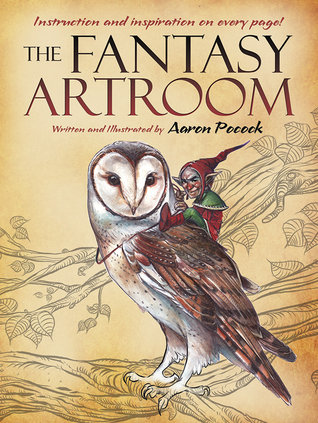
The Fantasy Artroom by Aaron Pocock

book cover
The Fantasy Artroom
by Aaron Pocock


ISBN-13: 9780486801247
Paperback: 160 pages
Publisher: Dover Publications
Released: May 18, 2016

Source: ebook review copy from the publisher through NetGalley.

Book Description, Modified from NetGalley:
Do you love to create imaginative artwork? Would you like to add depth and richness to your creations? Could you use fresh inspiration? Here is the book that will help you brush up on your skills and add new tricks and techniques to your repertoire.

These step-by-step demonstrations offer easy-to-follow methods for drawing trees and landscapes; forming dwarves, witches, mermaids, centaurs, and other characters; and putting them all together into enchanting compositions. Introduce a new dimension to your drawing, line art, and watercolor images with this richly illustrated guide and its helpful exercises, tips, and suggestions.


My Review:
The Fantasy Artroom teaches how to draw, ink, and use watercolor to create fantasy artwork. The author assumed that you have no art training. He generally suggested the minimal necessary tools to get you started, and he gave tips on how to use these tools to get good results. He provided step-by-step demonstrations on how to draw a scene element (like a rock, tree, dragon, water, etc.) or whole fantasy scene. He broke the steps down enough that I felt confident as I did the demo and in using that information to create my own scenes. He was very encouraging and made art seem do-able for everyone.

He taught how to sketch or draw a scene, how to ink the scene using a dip pen or ink pens, and how to paint colored scenes using watercolors. His tips on using dip pens and watercolors were very useful. He showed how to use reference photographs, like using a picture of a lizard to create a better dragon. He talked about composing and story-telling in the scene. He provided demos on landscape elements, texture, and a variety of fantasy creatures (from griffins to trolls, mermaids, fairies, and more).

I'd highly recommend this book to anyone--young or old--who would like to learn how to create or improve their fantasy artwork.


If you've read this book, what do you think about it? I'd be honored if you wrote your own opinion of the book in the comments.


Excerpt: Read an excerpt using Google Preview.

Monday, June 20, 2016

Oil Painting Essentials by Gregg Kreutz

book cover
Oil Painting Essentials
by Gregg Kreutz


ISBN-13: 9780804185431
Paperback: 160 pages
Publisher: Watson-Guptill
Released: May 24, 2016

Source: ebook review copy from the publisher through NetGalley.

Book Description, Modified from Goodreads:
Many painters limit themselves to a particular genre out of habit or fear, but in Oil Painting Essentials, art instructor Gregg Kreutz reveals how connected oil painting techniques are no matter what subject an artist tackles. Arranged by essential artistic focal points, each chapter reveals the challenges and rewards that painters face when covering specific genres.

Through step-by-step lessons and examples from the works of oil painting masters past and present, Kreutz shows how artists can strengthen their skillset for one type of subject matter by painting in another area they may not be as familiar with. This comprehensive breakdown of oil painting provides all of the tools that painters need to successfully take on any type of oil painting.


My Review:
Oil Painting Essentials was about aspects of composition that the author then applied to painting portraits, naked women, still lifes, cityscapes, and interiors. It's not a "how to paint" book, and these principles apply to more than just oil painting. If you've got a decent painting but you feel like it's lacking something, he'll suggest how to add "drama" to your painting.

He teaches you to paint in the same style that he does. He paints backgrounds with little to no detail--and often very dark--then he spotlights his point of interest, which is painted in detail. Some of his favorite principles were about being selective about what to show in detail, using contrasting colors or values, and making light the main event.

He did include basic painting principles that apply to all styles of painting. He also did a good job of defining what he meant by a term so I wasn't confused. The paintings that he used to illustrate a point were good at showing that point. If you like his style, he'll certainly help you to paint that way.

But I didn't really care for his style as the subjects lack context. Also, I sometimes wondered about his tips when he'd say something like, 'this makes the fruit clearly look like a nectarine' and I'm thinking, 'oh, is that what it is? I thought maybe it was an apple.' So his tips didn't always work on me.


If you've read this book, what do you think about it? I'd be honored if you wrote your own opinion of the book in the comments.


Excerpt: Read an excerpt using Google Preview.

Tuesday, June 7, 2016

Saving My Assassin by Virginia Prodan

book cover
Saving My Assassin
by Virginia Prodan


ISBN-13: 9781496411846
Trade Paperback: 304 pages
Publisher: Tyndale House Publishers
Released: June 7, 2016

Source: Review copy from the publisher.

Book Description, Modified from Back Cover:
At just under five feet tall, Virginia Prodan was no match for the towering 6' 10" gun-wielding assassin the Romanian government sent to her office to take her life. It was not the first time her life had been threatened--nor would it be the last.

As a young attorney under Nicolae Ceausescu's brutal communist regime, Virginia had spent her entire life searching for the truth. When she finally found it in the pages of the most forbidden book in all of Romania, Virginia accepted the divine call to defend fellow followers of Christ against unjust persecution in an otherwise ungodly land.

For this act of treason, she was kidnapped, beaten, tortured, placed under house arrest, and came within seconds of being executed under the orders of Ceausescu himself. A must-read for all generations, "Saving My Assassin" is the unforgettable account of one woman's search for truth, her defiance in the face of evil, and a surprise encounter that proves without a shadow of a doubt that nothing is impossible with God.


My Review:
Saving My Assassin is a memoir about Virginia Prodan's life in Romania. It starts in 1961 (when she was 6 years old) and ends in 1988 (plus an epilogue). It's an awesome story about God's work in Romania and how he used Virginia to make a difference.

The author talked about growing up under the communist regime of Nicolae Ceausescu. Due to certain family circumstances, she longed to find (and defend) the truth and thought she could do this as an attorney. She described the challenges of working as an attorney and following Christ in those years. She talked about some of the cases she took defending Christians and the threats and harm she endured for doing so.

Her story gives God glory for working things together for good--even when she couldn't see it at the time. Like when she faced an assassin in her office or felt completely cut off from any friends during a house arrest. It's an amazing and encouraging story, and I had a hard time putting down. I'd highly recommend it to anyone interested in what life was like in Romania under Ceausescu and to Christians seeking encouragement about taking risks when God calls you to them.


If you've read this book, what do you think about it? I'd be honored if you wrote your own opinion of the book in the comments.


Excerpt: Read an excerpt using Google Preview.

Friday, June 3, 2016

Indian Boyhood by Charles Eastman

book cover
Indian Boyhood
by Charles Eastman


ISBN-13: 978-1-937786-56-45
Hardback: 40 pages
Publisher: Wisdom Tales
Released: 1902; June 7, 2016

Source: Review copy from the publisher.

Book Description, Modified from Publisher website:
Imagine a childhood where riding horses, playing in the woods, and hunting for food was part of everyday life; where a grizzly bear, a raccoon, or a squirrel was your favorite pet. But imagine, too, being an orphan at the age of six, being forced off your land by U.S. soldiers, and often going hungry. Such was the childhood of the first great American Indian author, Charles Eastman, or Ohiyesa (1858-1939).

Carefully edited for a younger audience by multiple award-winning author and editor, Michael Oren Fitzgerald, Indian Boyhood recalls Eastman’s earliest childhood memories. He was born in a buffalo hide tipi in western Minnesota, and raised in the traditional Dakota Sioux manner until he was fifteen years old. He was then transplanted into the “white man’s” world. Educated at Dartmouth College, he went on to become a medical doctor, renowned author, field secretary for the YMCA, and a spokesman for American Indians.


My Review:
Indian Boyhood is a picture book for ages 4 and up and it's an edited version of Charles Eastman's autobiography about his Dakota Sioux upbringing. Charles Eastman, or Ohiyesa, lived from (1858-1939) and wrote eleven books from 1902-1918. This book tells how he was raised by a grandmother due to losing his parents while very young and how they were forced off their land, but also about his wild-animal pets, hunting, and learning to be a warrior.

The illustrations complement the text by showing details of Indian life that aren't specifically mentioned in his narrative. Information about these extra details is included at the end of the book. The illustrations are done in the same style as that shown on the cover. All royalties are donated to various American Indian causes. I'd recommend this book to children interested in what a Dakota Indian childhood was like in 1858-1873.


If you've read this book, what do you think about it? I'd be honored if you wrote your own opinion of the book in the comments.


Excerpt: See more on the publisher's website.
book cover

Friday, May 27, 2016

Healing Berries by Kirsten Hartvig

book cover
Healing Berries
by Kirsten Hartvig


ISBN-13: 9781848991552
Paperback: 240 pages
Publisher: Watkins Publishing
Released: April 19, 2016

Source: ebook review copy from the publisher through NetGalley.

Book Description, Modified from NetGalley:
Berries are among the healthiest foods on the planet. Every month, new research is published describing the health-giving properties of a well-known or recently discovered berry. Most berries are easy to store and use out of season: they can be dried, preserved with alcohol or sugar, or frozen, and most of us can now find a wide selection of berries in supermarkets and specialist healthfood stores.

This book is a celebration of the health-giving properties of berries, as well as a treasure-trove of fabulous ways to use them in your cooking. The book includes 50 profiles of the healthiest and most popular species - including açai, cranberry, blueberry and redcurrant. Renowned nutritionist and naturopath Kirsten Hartvig also offers more than 100 recipes, from breakfasts and preserves to juices and liqueurs.


My Review:
Healing Berries is a guide to buying, storing, and using berries. In the first half of the book, the author provided profiles for 50 berries from all over the world. These include a few that you don't think of as berries. She provided historical and general information about each type of berry, where to find it, how it's commonly used, how to store it, a brief nutrition profile, and health benefits.

In the second half of the book, the author provided 100 recipes from around the world. They sound fairly simple to do, and many contained berries you can buy locally. They're intended to be healthy recipes, so the author suggests using organic, whole foods as ingredients. She included recipe variations for vegans. The recipes were for snacks, salads, soups, baked goods, deserts, preserves, juices, smoothies, liqueurs, breakfasts, and main dishes. Most of the recipes take between 10 to 40 minutes to make and serve 4 people.

The berries covered were: acai berry, aronia/chokeberry/barberry, bearberry, bilberry, blackberry, black currant, blueberry, boysenberry, caperberry, cherry, cloudberry, cranberry, crowberry, damson, dewberry, elderberry, goji berry, golden berry, gooseberry, grape, honeyberry, huckleberry, Indian gooseberry/amla, jujube/Chinese date, juniper, Kiwi fruit/Chinese gooseberry, lingonberry, loganberry, mulberry, Oregon grape, persimmon, raspberry, redcurrant, rose hip, rowan, salmonberry, sea-buckthorn, seagrape, serviceberry, sloe, strawberry, strawberry tree, sumac, thimbleberry, tomato, ugniberry, whitecurrant, whortleberry, wineberry.


If you've read this book, what do you think about it? I'd be honored if you wrote your own opinion of the book in the comments.


Wednesday, May 25, 2016

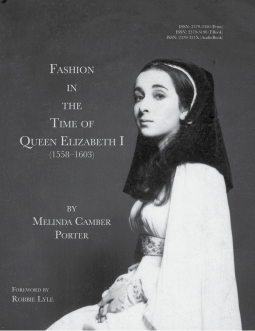
Fashion In The Time Of Queen Elizabeth I (1558-1603) by Melinda Camber Porter

book cover
Fashion In The Time Of Queen Elizabeth I (1558-1603)
by Melinda Camber Porter


ISBN-13: 9781942231103
ebook: 82 pages
Publisher: Blake Press
Released: May 16, 2016

Source: ebook review copy from the publisher through NetGalley.

Book Description, Modified from Goodreads:
Fashion in the Time of Queen Elizabeth I (1558-1603) was a hand written thirty-four page document on eight inch by twelve inch lined British school tablet paper with thirty-one separate drawings on white paper. Melinda Camber Porter wrote and illustrated this book as a school report in Second Grade (Class 2), where she attended The City of London School for Girls. Melinda's reference material appears to originate from the great British fashion writer and illustrator of the 1930s, Dion Clayton Calthrop, who wrote and illustrate many books on English fashion from 1050 A.D. to 1750 A.D.

The text of this book is typed from the original hand written text and includes reproductions of Melinda Camber Porter's original drawings. The book also serves as a piece of history for The City of London School for Girls, and includes photos and awards of Melinda Camber Porter in the appendices.


My Review:
Fashion In The Time Of Queen Elizabeth I (1558-1603) is about both Melinda Camber Porter and her report on English fashion in 1558-1603. The actual report described the clothing of English noblemen and noblewomen in some detail--from head to toe--and included changes in fashion and the names and uses of the different clothing items. In less detail, she described town and country clothing worn by men and women from the middle and lower classes and children's clothing. She drew nice illustrations for some of the clothing (see an example below), and I was impressed by the overall quality of her report. Though brief, it's very informative and even included some quotes from Elizabethan times describing clothing.

This book also included some information about the The City of London School for Girls and a short biography of Melinda Camber Porter. The appendix included a list of Melinda Camber Porter's writings and art exhibits, photos of the awards she won, quoted praise for her work, and a list of newspapers that ran her obituary.

I'd recommend this book to people interested in Melinda Camber Porter who would like to read her report on Elizabethan fashion.


If you've read this book, what do you think about it? I'd be honored if you wrote your own opinion of the book in the comments.


Monday, May 23, 2016

The Acrylic Painter by James Van Patten

book cover
The Acrylic Painter
by James Van Patten


ISBN-13: 9780385346115
Paperback: 304 pages
Publisher: Watson-Guptill
Released: June 2, 2015

Source: Review copy from the publisher through Blogging for Books.

Book Description, Modified from Goodreads:
Noted artist and School of Visual Arts instructor James Van Patten offers guidance on materials, processes, balance, and composition, and focuses on effectively using color in painting. He shows how acrylics can provide all painters with a vast range of possibilities for producing highly expressive art.

Readers will learn how to use acrylics to create a wide variety of effects--from watercolor-like transparency and the flatness of tempera and gouache, to the buttery quality of oil and collage adhesive and varnish--in everything from non-representational works to painterly realism to photorealism. Includes detailed step-by-step technical demonstrations and inspiring works by the author, his students, and other artists.


My Review:
The Acrylic Painter is a practical guidebook for those interested in painting with acrylics. You'll get the most benefit from his advice if you read this book before buying your supplies. I would have saved money and frustration if I'd had this advice. When I saw this book, I figured if the author could create huge, hyper-realistic landscape paintings using acrylic, he must know what I need to know! Indeed, he does, and he understands the types of things that a beginner with acrylics actually needs to know to enjoy the experience.

He discussed the pros and cons of different brands and types of acrylic paints. He also talked about what colors you need--he suggests starting with just five colors--and described the other supplies you'll need or may want in the future. He explained basic painting information like color theory, looking at the world in a way that helps you to paint what's actually there, and possible styles (abstract to hyper-realistic) and subjects (still life, portraits, landscapes). He also covered painting techniques like underpainting, using photographs and grids, tricks for painting hard edges, blending, glazing, and impasto painting. He ended by describing how to finish the painting's surface with protective layers and briefly described matting and framing your work.

There were some suggested exercises and demonstrations. They're practical things like how to blend large areas or create an underpainting. He used his and other people's paintings as illustrations to demonstrate various points from the text. While I'm getting fairly confident at painting in oil and watercolor, this book has definitely helped me understand how to successfully use acrylics.


If you've read this book, what do you think about it? I'd be honored if you wrote your own opinion of the book in the comments.


Excerpt: Read an excerpt using Google Preview.